TL;DR
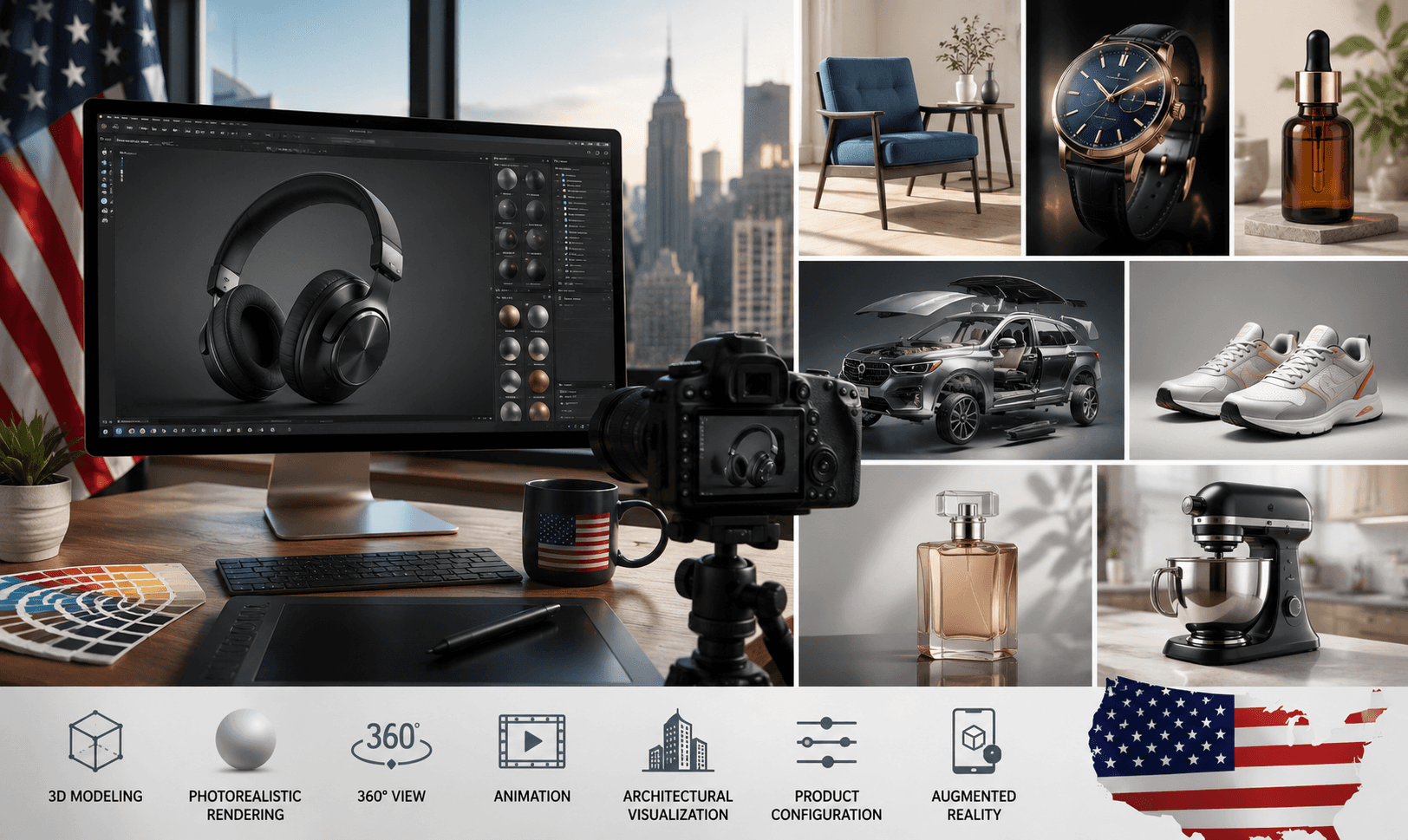
This guide reviews the seven best product visualization service providers in the USA for 2026, covering companies like Chaos, Smapit, Marxent, and Dizzbo. It explains what each studio does best, who they serve, and what they typically charge. The post also walks readers through how to choose the right studio based on budget, turnaround time, and product type. A final section compares CGI to traditional photography to help brands decide which approach makes more sense at different scales.
If you've ever scrolled past a product listing because the photos looked flat, dark, or just *wrong* — you already understand why product visualization matters. Buyers don't touch products online. They see them. And if what they see doesn't build confidence, they leave.
That's why brands across ecommerce, furniture, consumer electronics, and CPG are quietly replacing traditional photography with 3D product visualization services USA studios. Faster turnaround. Lower long-term costs. Perfect lighting every single time. No studio booking required.
But here's the thing: not every studio is built the same. Some are brilliant at lifestyle renders for Instagram. Others specialize in hyper-technical industrial products. And some are just expensive with mediocre portfolios hiding behind slick websites.
So we did the research. Below you'll find the real top players offering product visualization services in USA, what they actually do well, who they serve, and what you should watch out for before signing a contract.
The Top 7 Product Visualization Companies in the USA (2026)
1. Chaos (formerly known as Chaos Group) — Los Angeles, CA
Chaos is the company behind V-Ray, arguably the most widely used rendering engine in the world. Their photorealistic product rendering capabilities are elite-level, and major brands like IKEA and Autodesk have used their ecosystem. They're not a typical agency — they're more of a platform and studio hybrid, which makes them ideal for enterprises that want total visual control. Best for: architecture, automotive, and high-end product lines.
2. Smapit — USA (Remote-First, Nationwide)
Smapit has built a reputation for doing what most studios won't: combining smart CGI workflows with scalable ecommerce content production. They specialize in 3D product visualization services USA brands actually need — product renders, 360-degree spins, lifestyle scenes, and exploded views — all without the typical agency bloat or three-week turnaround.
What makes them different is the ecommerce-first mindset. They understand Amazon listing requirements, Shopify image specs, and D2C brand aesthetics. Furniture brands, consumer goods companies, and apparel accessories businesses have all benefited from their output.
If you're a growing brand that needs scalable ecommerce content without hiring a full in-house design team, Smapit is worth a serious look.
3. The Boundary — New York, NY
Based out of New York, The Boundary works primarily with architectural and product brands that need cinematic-quality CGI advertising visuals. They've collaborated with agencies and brands across luxury real estate and consumer products. Their renders are the kind that stop your thumb mid-scroll. The tradeoff? Their pricing reflects that premium positioning. If budget is tight, look elsewhere. If brand perception is everything, they deliver.
4. Marxent — Cincinnati, OH
Marxent has carved out a very specific niche: 3D product configuration for furniture and home goods retail. They work with brands like La-Z-Boy and Ashley Furniture — companies where customers need to see a sofa in twelve fabric options before clicking "add to cart." Their 3D modeling and rendering services integrate directly into product pages via AR and interactive configurators. If your product has variants, this team understands that complexity better than almost anyone.
5. Squint/Opera — New York, NY (US Office)
Originally a UK firm, Squint/Opera has a significant US presence and has handled visualization for major luxury brands, exhibitions, and retail experiences. Their strength lies in storytelling — they don't just render products, they build visual worlds around them. Think of it like the difference between a product photo and a movie still. Industries served include retail, hospitality, and brand experience. Premium pricing, premium results.
6. Dizzbo — San Diego, CA
Dizzbo focuses specifically on ecommerce product images USA sellers need for high-volume catalogs. They've built their entire workflow around speed and consistency — which matters a lot when you're launching 200 SKUs at once. Apparel, accessories, and small consumer goods are their wheelhouse. They also offer white-label services for agencies that want to outsource rendering work without the client knowing. Turnaround times are among the fastest you'll find.
7. 3D-Ace Studio — US Operations (Remote)
3D-Ace has been in the CGI industry for over 15 years and handles everything from product rendering services USA clients need to character design and environment art. Their product visualization work spans consumer electronics, medical devices, and industrial equipment. They're particularly strong when the product is technically complex — think circuit board details or mechanical components that need to look accurate, not just pretty. Mid-range pricing with serious quality.
Honorable Mentions
Visualskies (Los Angeles) brings strong architectural and real estate visualization experience that occasionally crosses into product work. RenderHub operates more as a marketplace than a studio but connects brands with freelance CGI talent across the US for smaller, budget-conscious projects.
Quick Comparison Table
Company | Specialization | Estimated Pricing | Best For |
|---|
Chaos | Enterprise rendering platform | $5,000 – $50,000+ per project | Large enterprises, automotive |
Smapit | Ecommerce CGI + scalable content | $75 – $500 per render | D2C brands, ecommerce sellers |
The Boundary | Luxury CGI advertising | $10,000 – $100,000+ campaigns | Premium brand campaigns |
Marxent | 3D configurators + furniture visualization | $5,000 – $30,000+ setup | Furniture, home goods retail |
Squint/Opera | Brand experience visualization | $15,000 – $100,000+ projects | Retail, hospitality, luxury |
Dizzbo | High-volume catalog rendering | $50 – $250 per render | Apparel, accessories, SKU-heavy catalogs |
3D-Ace Studio | Technical + industrial product rendering | $100 – $800 per render | Electronics, industrial, medical |
How to Choose the Right Product Visualization Company in the USA
This is where most brands make costly mistakes. They pick the studio with the flashiest website instead of the one that actually fits how they work.
Here's a cleaner way to think about it:
1. Pricing models matter more than hourly rates
Some 3D rendering companies USA charge per image. Others bundle projects. A per-render rate of $150 sounds expensive until you realize it includes three revision rounds and a lifestyle background — things that cost extra elsewhere. Always ask for a full scope breakdown, not just a headline number.
Typical cost ranges in 2026: $50–$150 per simple product render, $200–$500 for complex lifestyle scenes, and $1,000–$5,000+ for full campaign packages with multiple angles, environments, and formats.
2. Turnaround time is a dealbreaker for ecommerce
If you're launching on Amazon Prime Day, a studio that takes four weeks per batch won't cut it. Ask specifically: what's the turnaround for a 10-image project? What happens if revisions are needed? Some product visualization agencies USA have this dialed in. Others don't.
3. Look at portfolio depth, not just highlights
Every studio shows their best work. Ask to see their *average* work. Ask for examples from your specific product category. A studio that's stunning at furniture renders might struggle with reflective plastics or transparent glass packaging.
4. Industry specialization versus generalist capability
For technical products, go specialist. For lifestyle ecommerce, a generalist studio often works fine — and costs less. Matching the studio's strength to your product type is the fastest way to get quality output without overpaying.
CGI vs. Traditional Photography: Which Wins in 2026?
Short answer: it depends on your volume.
One-off hero shots? Photography can still win on budget. But the moment you're dealing with multiple colorways, 360-degree views, size variations, or global campaign assets — CGI product visualization companies become dramatically more cost-effective.
Think about it this way. A photographer can shoot your red sofa on Tuesday. But when you need to show it in charcoal, beige, ocean blue, and forest green — plus place it in a modern loft, a beach house, and a cozy apartment — you're looking at multiple shoot days, model home rentals, and lighting crews. A CGI studio does all of that from the same base 3D file, usually in less time and for a fraction of the cost at scale.
That's why product visualization vs photography USA is increasingly a scale question rather than a quality one.
Frequently Asked Questions
What is product visualization?
Product visualization is the process of creating digital images or animations of a product — usually using 3D modeling and rendering software — so that it looks photorealistic without needing physical photography. Brands use it for ecommerce listings, advertising, packaging mockups, and product launches.
How much does 3D rendering cost in the USA?
Costs vary widely. A simple hero render from a mid-tier studio typically runs $75–$200. Complex lifestyle renders with custom environments range from $250–$600. Full campaign packages with multiple products, angles, and formats can reach $2,000–$10,000 depending on scope.
Which is better: CGI or photography?
For high-volume ecommerce and variant-heavy products, CGI wins on cost-efficiency and flexibility. For single-product hero shots where budget allows, photography can feel more "immediate." Most serious brands use both strategically.
How do I know if a 3D rendering company is reliable?
Look for verifiable clients, real portfolio samples in your product category, transparent pricing, and a clearly defined revision policy. Ask about their internal team size — very small freelance operations can be great but may struggle with scale.
Can product visualization services help with Amazon listings?
Yes — and significantly. Studios experienced in ecommerce product images USA will deliver assets formatted specifically for Amazon's main image requirements, A+ content, and 360-degree spin programs.
Conclusion
The product visualization services in USA market is genuinely crowded — but most providers fall into two camps: expensive generalists and cheap-but-inconsistent freelancers. The sweet spot is finding a studio that understands your product category, can scale with your catalog, and communicates clearly without making you feel like you need a PhD to read their invoices.
For brands serious about ecommerce growth in 2026, investing in quality 3D product visualization services USA isn't a luxury — it's a competitive advantage that compounds over time. Better visuals mean higher conversion rates, fewer returns, and stronger brand perception across every channel.
Take the comparison table, apply the "how to choose" criteria to your specific situation, and don't let a pretty studio portfolio distract you from the fundamentals: turnaround, pricing transparency, and category experience.
Looking for scalable product visualization that actually fits your ecommerce workflow? Explore what Smapit can do for your brand — fast turnarounds, ecommerce-ready formats, and CGI that converts.
Disclaimer:
The information provided in this article is for general informational purposes only. Company details, pricing estimates, and service capabilities are based on publicly available data and industry insights, and may vary depending on project scope and specific requirements. This content does not constitute professional or financial advice, nor does it represent endorsements of any listed providers. Readers are encouraged to conduct their own research and contact service providers directly before making any business decisions.