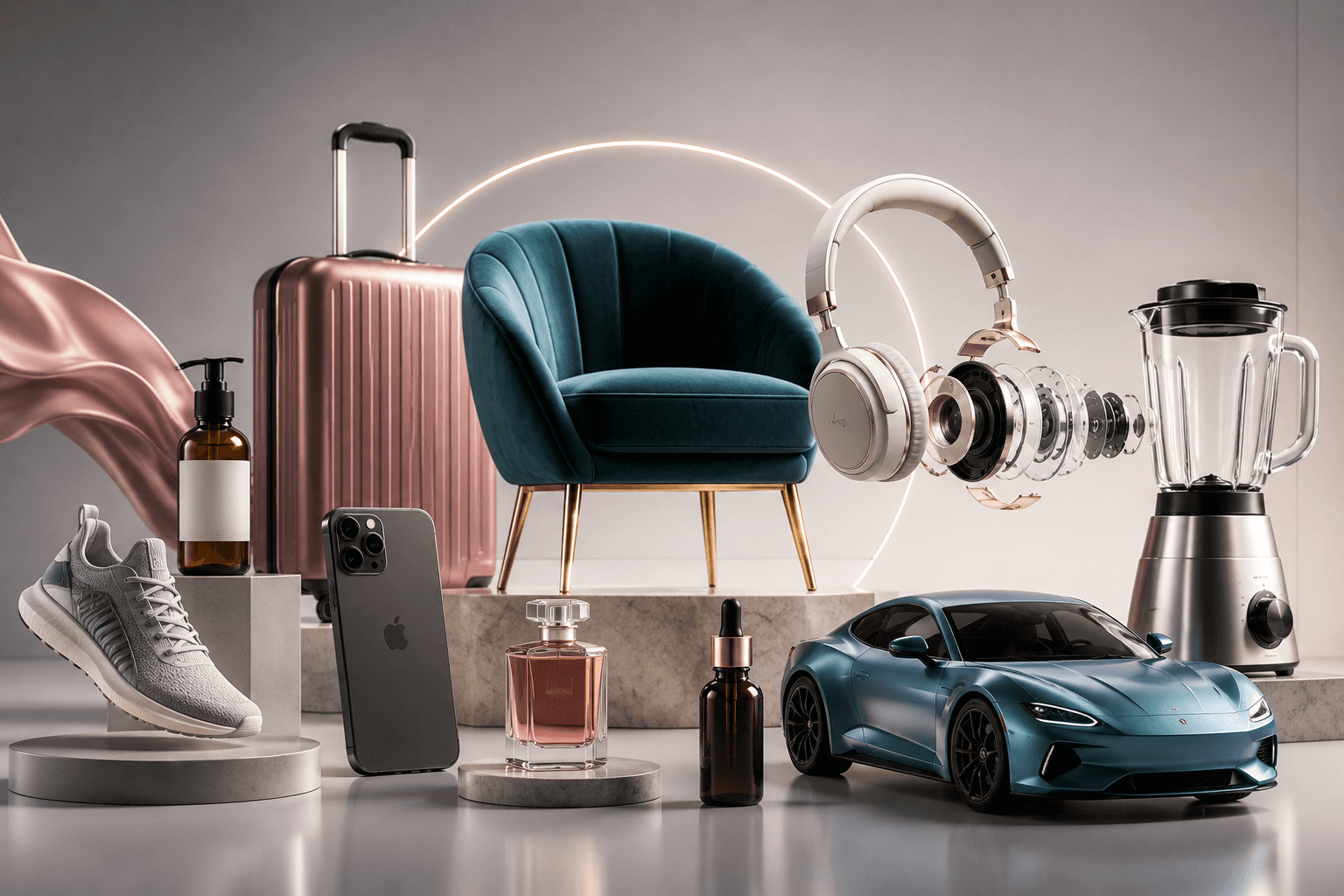
By SMAPIT Studio Team | Updated: May 2026 | Reading Time: 9 mins
Table of Contents
Introduction: CGI Product Photography Is No Longer a Luxury — It's a Standard
What Is CGI Product Photography?
Why Traditional Photography Is Failing Modern Brands
Top 7 Industries Benefiting Most From CGI Product Photography
Industry 1: Consumer Electronics and Gadgets
Industry 2: Furniture and Home Décor
Industry 3: Beauty, Skincare, and Personal Care
Industry 4: Fashion and Accessories
Industry 5: Food, Beverage, and Packaging
Industry 6: Automotive and Auto Accessories
Industry 7: Health, Wellness, and Fitness Equipment
CGI vs Traditional Photography: Industry-by-Industry Breakdown
How SMAPIT Serves Every Industry With World-Class CGI
Real Brand Results Across Industries
FAQs About CGI Product Photography by Industry
Final Thoughts: Which Industry Will You Transform Next?
Introduction: CGI Product Photography Is No Longer a Luxury — It's a Standard
There was a time when CGI product photography was reserved for luxury car commercials, Hollywood visual effects, and the biggest global consumer brands with multimillion-dollar marketing budgets. That time is over.
Today, a furniture startup in Bengaluru, a skincare brand launching on Amazon US, and a fitness equipment company scaling across the Middle East are all using CGI product photography — producing visuals that rival the output of major advertising studios, at a fraction of the traditional cost.
The reason is simple. CGI has democratized visual excellence. And the brands that understand this earliest — by industry — are the ones pulling ahead in search rankings, conversion rates, and customer trust.
But CGI product photography doesn't deliver equal value across every category. Certain industries see dramatically outsized returns because of the specific visual challenges their products present — challenges that traditional photography simply cannot solve efficiently or affordably.
This article identifies the top 7 industries where CGI product photography delivers the greatest competitive advantage, explains why traditional shoots fall short in each, and shows how SMAPIT delivers photorealistic CGI across every one of them.
What Is CGI Product Photography?
CGI product photography is the creation of photorealistic product images using 3D modeling software and computer-generated imagery — without a physical camera, studio, or lighting rig.
A 3D artist builds a precise digital model of your product, complete with accurate materials, textures, surface finishes, and dimensions. That model is then placed inside a virtual environment — a lifestyle scene, a white studio, an outdoor setting, or any custom backdrop — and rendered into a final image or video that is indistinguishable from a real photograph.
The output covers everything from simple white-background silo shots for Amazon compliance to complex lifestyle scenes, 360-degree interactive views, A+ content modules, exploded technical renders, product animations, and AR-ready assets.
Studios like SMAPIT — a CGI and 3D visualization studio based in Gurugram, India — have built AI-powered production pipelines that deliver this full spectrum of CGI product photography across industries, at scale, within 3 to 5 business days per product.
Why Traditional Photography Is Failing Modern Brands
Before diving into industries, it's important to understand why traditional photography is increasingly inadequate for modern e-commerce brands — regardless of category.
Cost is unsustainable at scale. A single product photoshoot with a professional studio, photographer, lighting setup, props, and post-production retouching can cost anywhere from ₹15,000 to ₹1,50,000 or more per product. For brands managing 50, 100, or 500 SKUs across multiple variants, the math becomes impossible.
Speed is too slow for competitive markets. A traditional photoshoot takes 2 to 4 weeks from scheduling to final delivery. In fast-moving product categories like electronics or beauty, that timeline means listing delays, missed launch windows, and revenue left on the table.
Flexibility is almost nonexistent. Once a product is photographed, changing the background, adding a seasonal element, or adjusting the lighting requires a full reshoot. CGI makes all of these changes in software — in hours, not weeks.
Consistency breaks down across catalogs. Different shoots, different photographers, different studios — the result is a product catalog that looks visually fragmented. CGI produces pixel-perfect consistency across every SKU, every variant, every platform.
Physical limitations block creative vision. Some products are simply difficult or impossible to photograph effectively in the real world — transparent materials, highly reflective surfaces, miniature components, or products that don't yet physically exist.
CGI product photography solves every one of these problems. And in certain industries, it doesn't just solve them — it transforms what's visually possible entirely.
Top 7 Industries Benefiting Most From CGI Product Photography
Industry 1: Consumer Electronics and Gadgets
Why this industry needs CGI most: Consumer electronics present some of the most visually demanding challenges in product photography. Glossy screens reflect studio lights. Metallic chassis create unwanted glare. Transparent components reveal internal wiring. Black devices disappear against dark backgrounds. Cables tangle. Buttons are too small to capture crisply at full product scale.
Traditional photographers spend enormous amounts of time — and brands spend enormous amounts of money — fighting these physical limitations on every shoot. And then the product gets updated, a new color variant launches, or the packaging changes — and the entire process starts again.
CGI product photography eliminates every one of these challenges at the source. Materials are defined digitally, so metallic finishes reflect exactly as intended. Screen glare is controlled in software. Every surface catches light perfectly. Transparent elements are rendered with precise optical accuracy. And when a new color variant launches, it takes hours to update the material in the 3D model — not days to reshoot.
Specific CGI deliverables that transform electronics brands:
Silo renders with perfect black or white backgrounds that meet Amazon's compliance requirements without any retouching. Lifestyle renders showing devices in real-world usage environments — a laptop open on a home office desk, earbuds beside a running track, a smartwatch on a wrist. Exploded view renders that reveal internal components and signal build quality. 360-degree spin renders that let customers examine every angle of a device before buying. Product animations for unboxing sequences and feature highlight videos.
The traditional photography problem in electronics: A realistic studio shoot for a single electronics product — with correct lighting to handle reflective surfaces, multiple angles, lifestyle scenes, and post-production retouching — can cost ₹50,000 to ₹2,00,000 or more. For a brand with 20 SKUs across three color variants, that's 60 individual product configurations to shoot. CGI collapses that cost dramatically.
SMAPIT's electronics clients include Mivi — a leading Indian audio electronics brand — for whom SMAPIT has produced product renders, lifestyle visuals, and campaign imagery that has powered their Amazon presence and social media advertising.
Primary keywords: CGI product photography electronics, 3D renders consumer electronics, product visualization gadgets, photorealistic electronics renders
Industry 2: Furniture and Home Décor
Why this industry needs CGI most: Furniture is one of the most logistically nightmarish categories for traditional photography. Products are large, heavy, and expensive to ship. A full living room set requires an entire studio space to photograph — along with styling, props, and potentially models. Photographing a sofa in five different fabric variants means either manufacturing five physical sofas or doing five separate shoots.
The economics simply don't work at scale. And yet furniture is one of the categories where visual quality most directly drives purchase decisions. Customers buying a ₹30,000 sofa or a ₹15,000 dining table need to see it in context — how it looks in a room, how the fabric drapes, how the finish catches light at different times of day.
CGI lifestyle renders deliver exactly this — without the logistics. A single 3D model of the sofa can be placed in a Scandinavian living room, a warm maximalist study, or a contemporary open-plan apartment. Fabric variants are changed in software. Finish options — matte, gloss, walnut, oak — are material swaps, not reshoots.
Specific CGI deliverables that transform furniture brands:
Room scene lifestyle renders that show furniture in aspirational, fully styled interiors. Material and finish variant renders — producing every color and texture option from one 3D model. AR-ready assets that allow customers to place furniture in their own room via smartphone. 360-degree views that let customers examine joinery, leg design, and cushion depth from every angle. Scale reference renders that show furniture proportionally within room dimensions.
The traditional photography problem in furniture: Shipping a large sofa to a photography studio, styling a complete room set around it, and photographing multiple variants can cost ₹1,00,000 or more per product. With CGI, the same output costs a fraction — and the 3D model becomes a reusable asset for AR, animation, and future campaigns.
Primary keywords: CGI furniture photography, 3D furniture renders, lifestyle renders home décor, furniture product visualization, AR furniture rendering
Industry 3: Beauty, Skincare, and Personal Care
Why this industry needs CGI most: Beauty and skincare is one of the fastest-moving product categories in e-commerce. New SKUs launch constantly. Packaging is updated regularly. Seasonal limited editions come and go. And every product needs to look absolutely flawless — because in beauty, visual perfection is the brand promise.
Traditional photography of beauty products is deceptively difficult. Glass bottles distort light unpredictably. Metallic pumps create harsh reflections. Liquid products inside transparent packaging require specialized lighting to render correctly. Small typographic details on packaging must be pin-sharp. And the slightest imperfection — a fingerprint on the bottle, a slightly off-center label — means a reshoot.
CGI product photography delivers beauty images with mathematical precision. Every surface catches light exactly as specified. Label text is perfectly crisp at any resolution. Glass transparency and liquid depth are rendered with physical accuracy. And because the 3D model is the master asset, every new color, size, or limited edition variant is a material and label update — not a new shoot.
Specific CGI deliverables that transform beauty brands:
Silo renders with flawless white backgrounds for Amazon and Nykaa listings. Lifestyle renders showing products styled on bathroom shelves, vanity tops, or spa settings. Bundle and range renders showing full product families together. Ingredient or formula highlight renders for A+ content. Seasonal campaign renders with festive or limited edition creative treatments.
The traditional photography problem in beauty: The combination of complex materials, high quality standards, frequent product updates, and large SKU catalogs makes beauty one of the most expensive categories for traditional photography. CGI cuts both cost and turnaround time — while consistently delivering the flawless quality the category demands.
Primary keywords: CGI beauty product photography, skincare product renders, 3D cosmetics visualization, beauty product CGI images, photorealistic skincare renders
Industry 4: Fashion and Accessories
Why this industry needs CGI most: Fashion photography has traditionally required models, stylists, makeup artists, locations, and significant production overhead. For accessory categories — bags, belts, jewellery, watches, sunglasses, wallets — the challenge is slightly different but equally significant. Small, intricate details must be captured with precision. Reflective metal, delicate stitching, gemstone clarity, and material texture all need to read correctly at thumbnail size on a mobile screen.
CGI product photography for fashion and accessories solves the detail problem definitively. A leather bag's grain texture is modeled at microscopic scale. A watch's dial is rendered with perfect clarity down to individual markers. A gemstone's facets catch virtual light with physically accurate refraction. All without a macro lens, a specialized lighting rig, or a skilled product photographer who charges premium rates for technical detail work.
For brands with multiple colorways — a bag available in twelve colors, sunglasses in eight frame combinations — CGI is transformative. Every variant is rendered from the same model, with material swaps handled in software.
Specific CGI deliverables that transform fashion and accessory brands:
Detail renders that zoom into stitching, clasps, hardware, and texture at levels of clarity traditional photography struggles to achieve. Colorway and variant renders produced from a single 3D model. Flat-lay style renders for editorial and catalog use. Lifestyle renders showing accessories worn or carried in aspirational real-world settings. Jewellery renders with precise gemstone light interaction.
The traditional photography problem in fashion: Accessory photography at high quality is expensive and slow. Jewellery in particular requires specialized photographers with macro equipment and extensive lighting knowledge. CGI delivers equivalent or superior results faster and at a fraction of the cost — with infinite variant flexibility.
Primary keywords: CGI fashion photography, accessory product renders, 3D jewellery visualization, watch product CGI, handbag product rendering
Industry 5: Food, Beverage, and Packaging
Why this industry needs CGI most: Food and beverage photography is widely regarded as one of the most specialized and expensive disciplines in commercial photography. Food stylists, prop stylists, specialized photographers, and controlled studio environments are all required — and even then, food degrades under studio lighting, liquids separate, ice melts, and fresh produce wilts within minutes of plating.
For packaged food and beverage brands — which represent the majority of FMCG e-commerce — the product isn't the food itself but the packaging. And CGI product photography handles packaging with exceptional precision. A cereal box's print design is applied as a texture map to a perfect 3D model. A beverage can's embossed logo catches light correctly. A sauce bottle's label reads clearly and the liquid inside is rendered with accurate color and depth.
CGI also enables something traditional food photography can never easily deliver — environment and context at scale. A beverage brand can show their can in a beach setting, a gym bag, a mountain sunrise, and a festival crowd — all without a single location shoot.
Specific CGI deliverables that transform food and beverage brands:
Packaging renders for Amazon, Flipkart, and supermarket listing images. Lifestyle renders showing products in consumption contexts. Bundle and range renders showing full product families. Seasonal and campaign renders for limited editions. Condensation and liquid splash renders that create appetite appeal without physical food styling.
The traditional photography problem in food: Physical food photography is time-sensitive, expensive, and difficult to scale. CGI packaging renders solve the scale and cost problem entirely — while delivering consistent, platform-ready quality across an entire product range.
Primary keywords: CGI food packaging photography, beverage product renders, FMCG product visualization, 3D packaging renders, food product CGI images
Industry 6: Automotive and Auto Accessories
Why this industry needs CGI most: The automotive industry was one of the earliest adopters of CGI product photography — because the challenge of photographing cars, motorcycles, and auto accessories at the quality level consumers expect is enormous. Full vehicle shoots require massive studios, professional lighting rigs, specialist automotive photographers, and significant post-production work. The cost is prohibitive for anything below a major OEM budget.
But the automotive accessories market — dashcams, seat covers, tyres, alloy wheels, car care products, audio systems, lighting upgrades — is a booming e-commerce category where most brands are not OEMs. They're mid-sized sellers on Amazon and their own DTC channels, selling products that need to look exceptional but can't afford exceptional traditional photography budgets.
CGI product photography serves this market perfectly. A set of alloy wheels can be rendered on a range of vehicle types without photographing a single car. A dashcam can be shown installed on a windscreen in multiple car interior environments. A tyre can be rendered from every angle with precise tread detail and sidewall branding clarity.
Specific CGI deliverables that transform automotive brands:
Product-in-context renders showing accessories installed on vehicles. Detail renders capturing tread patterns, finish quality, and component precision. Lifestyle renders in road and environment settings. 360-degree renders for wheels, tyres, and accessories. Animation renders demonstrating installation or functionality.
The traditional photography problem in automotive: Even accessory photography in this category requires access to vehicles, outdoor or large-studio environments, and specialized production. CGI removes every physical constraint — and produces imagery that often surpasses what's achievable in a real-world shoot.
Primary keywords: CGI automotive photography, car accessory product renders, 3D automotive visualization, tyre product CGI, alloy wheel renders
Industry 7: Health, Wellness, and Fitness Equipment
Why this industry needs CGI most: Health, wellness, and fitness equipment spans an enormous range of product types — from compact resistance bands and yoga mats to large treadmills, multi-station gym rigs, and complex physiotherapy devices. The visual challenge varies dramatically across this range, but one problem is consistent: scale.
Large fitness equipment is expensive to ship to studios, difficult to light at full scale, and nearly impossible to show in realistic home or gym environments without significant production investment. Small wellness products — essential oil diffusers, massage guns, supplement containers — face the opposite problem: they're detail-rich products where surface finish and material quality must read clearly at small sizes.
CGI product photography handles both ends of this spectrum with equal precision. A treadmill is built as a 3D model and placed in a photorealistic home gym environment — complete with rubber flooring, mirrors, and motivational lighting — without a single piece of equipment being shipped anywhere. A massage gun's textured grip surface and branded details are modeled and rendered with clarity that traditional macro photography would struggle to match consistently.
Specific CGI deliverables that transform health and fitness brands:
Lifestyle renders showing large equipment in home gym or commercial gym environments. Detail renders for grip textures, display screens, and mechanical components. Color and variant renders for products available in multiple finishes. Exploded view renders for complex multi-component fitness systems. A+ content image sets for Amazon Brand Registered fitness sellers. Product animation renders demonstrating movement, folding mechanisms, or adjustment features.
The traditional photography problem in fitness: Large equipment shoots are logistically and financially prohibitive for most mid-sized fitness brands. CGI makes showroom-quality visuals accessible at any budget level — and makes variant photography virtually free once the 3D model exists.
Primary keywords: CGI fitness equipment photography, health product renders, 3D wellness product visualization, gym equipment CGI, fitness product rendering services
CGI vs Traditional Photography: Industry-by-Industry Breakdown
Industry | Biggest Traditional Photography Challenge | CGI Solution | CGI Advantage Level |
|---|
Consumer Electronics | Reflections, glare, variant volume | Digital material control, instant variants | ⭐⭐⭐⭐⭐ |
Furniture & Home Décor | Size, shipping, room staging | Virtual environments, material swaps | ⭐⭐⭐⭐⭐ |
Beauty & Skincare | Surface complexity, frequent updates | Precision rendering, fast iteration | ⭐⭐⭐⭐⭐ |
Fashion & Accessories | Detail precision, colorway volume | Microscale modeling, variant rendering | ⭐⭐⭐⭐ |
Food & Beverage | Food degradation, packaging scale | Packaging CGI, context environments | ⭐⭐⭐⭐ |
Automotive | Vehicle access, studio scale | In-context renders, no vehicle needed | ⭐⭐⭐⭐⭐ |
Health & Fitness | Equipment size, variant complexity | Virtual gym environments, component detail | ⭐⭐⭐⭐⭐ |
How SMAPIT Serves Every Industry With World-Class CGI
SMAPIT is a CGI and 3D visualization studio headquartered in Gurugram, India, with operations serving brands across India, the United States, and the UAE. With 4+ years of deep 3D production expertise and an AI-integrated pipeline, SMAPIT delivers photorealistic CGI product photography across every industry covered in this article — trusted by 50+ brands.
What makes SMAPIT the right CGI partner across industries:
Deep category expertise. SMAPIT's team understands the specific visual challenges of each product category — the way light interacts with a glass beauty bottle is fundamentally different from how it behaves on a matte fitness equipment surface. Their artists bring category-specific knowledge to every project brief.
One 3D model, every deliverable. Regardless of industry, SMAPIT builds one precise 3D master model per product and uses it to produce every required deliverable — silo shots, lifestyle renders, A+ content, animations, AR assets — without rebuilding from scratch for each format.
AI-powered production at scale. SMAPIT's AI Labs division enhances CGI production with artificial intelligence tools — enabling faster scene generation, smarter lighting optimization, and high-volume creative output that traditional studios cannot match on speed or cost.
Platform-ready output. Every deliverable is formatted and optimized for its target platform from the first delivery — Amazon compliance, Shopify AR compatibility, Meta ad specifications, and more.
Global timezone coverage. Operating across IST, GST, and EST, SMAPIT maintains continuous production progress — meaning faster turnarounds for brands in India, the Middle East, and North America.
👉 Explore SMAPIT's CGI ad creatives
Real Brand Results Across Industries
SMAPIT's cross-industry client portfolio demonstrates the breadth and depth of their CGI expertise:
Mivi (Consumer Electronics) — SMAPIT produced product renders and lifestyle campaign imagery for this leading Indian audio brand, powering their Amazon listings and social media advertising across multiple product lines.
Agaro (Home Appliances) — SMAPIT delivered 3D product animation for Agaro that translated complex product functionality into visually compelling motion content — praised by the brand for capturing both design and utility with exceptional clarity.
LuvLap (Baby and Lifestyle) — SMAPIT produced complete product visualization sets for this trusted baby products brand, covering listing images, lifestyle renders, and campaign visuals.
Luminous (Home Electrical) — SMAPIT's CGI work for Luminous demonstrated the studio's ability to handle technically complex products with precision rendering and platform-ready output.
Cockatoo (Fitness Equipment) — SMAPIT produced fitness equipment renders for Cockatoo, showcasing large products in realistic environments without the logistical complexity of traditional studio shoots.
FAQs About CGI Product Photography by Industry
Is CGI product photography suitable for small brands or only large ones?
CGI product photography is accessible and cost-effective for brands of all sizes. The initial investment in 3D modeling is offset by the elimination of recurring photography costs — making CGI particularly advantageous for growing brands that need to scale their visual content without proportional cost increases.
Which industry benefits most from CGI product photography?
Consumer electronics, furniture, and automotive accessories tend to see the highest ROI from CGI because of the combination of complex physical photography challenges and high SKU or variant volume. However, every industry covered in this article sees significant advantages over traditional photography.
Can CGI images pass as real photographs on Amazon?
Yes. Modern CGI product photography is photorealistic to the degree that most consumers — and Amazon's own systems — cannot distinguish rendered images from photographs. Amazon explicitly permits CGI renders on product listings, provided they accurately represent the product.
How does SMAPIT handle industry-specific technical requirements?
SMAPIT's team researches and understands the specific material properties, surface behaviors, and visual conventions of each product category before beginning production. Category briefs, reference materials, and technical specifications are gathered upfront to ensure every render is accurate to the product and appropriate for its industry context.
What if my product has not been manufactured yet?
SMAPIT regularly produces pre-launch CGI renders from CAD files, technical drawings, packaging artwork, and design references — across every industry. This enables brands to build listings, run pre-launch campaigns, and generate early demand before the product physically exists.
How much does CGI product photography cost compared to traditional photography?
Costs vary by project scope, product complexity, and deliverable types required. However, brands consistently report savings of 60 to 70% on visual production budgets after switching to CGI — particularly for brands managing multiple SKUs or color variants across large catalogs.
Final Thoughts: Which Industry Will You Transform Next?
CGI product photography isn't a trend. It's a structural shift in how visual content is produced — and it's already the standard operating procedure for the most competitive brands across every major product category.
Whether you're selling consumer electronics on Amazon, launching a skincare brand on Nykaa, scaling a furniture DTC store, or building an automotive accessories catalog, the visual challenges you face are real — and CGI product photography solves them more effectively, more affordably, and more scalably than traditional photography ever could.
SMAPIT brings world-class CGI product photography to brands across every industry covered in this guide — with the technical expertise, AI-powered production pipeline, and cross-industry experience to deliver results that move the needle on conversions, brand perception, and catalog scalability.
The question isn't whether your industry can benefit from CGI product photography. The question is how much longer you can afford not to use it.
👉 Get Your Free Sample Render From SMAPIT