Table of Contents
What Are Product Rendering Services?
The Problem With Traditional Product Photography
Top 10 Reasons to Switch to Product Rendering Services
Reason 1: Cut Production Costs by Up to 70%
Reason 2: Faster Turnaround Without Compromising Quality
Reason 3: Unlimited Creative Flexibility
Reason 4: Perfect Consistency Across Every SKU
Reason 5: Scale Your Catalog Without Extra Shoots
Reason 6: Platform-Ready Visuals From Day One
Reason 7: Future-Proof With AR and 360° Views
Reason 8: No Physical Product Required
Reason 9: Easier Iteration and Version Control
Reason 10: Higher Conversions and Better ROI
CGI Product Rendering vs Traditional Photography: Quick Comparison
Who Should Use Product Rendering Services?
How SMAPIT Delivers World-Class Product Rendering
FAQs About Product Rendering Services
Final Verdict
What Are Product Rendering Services?
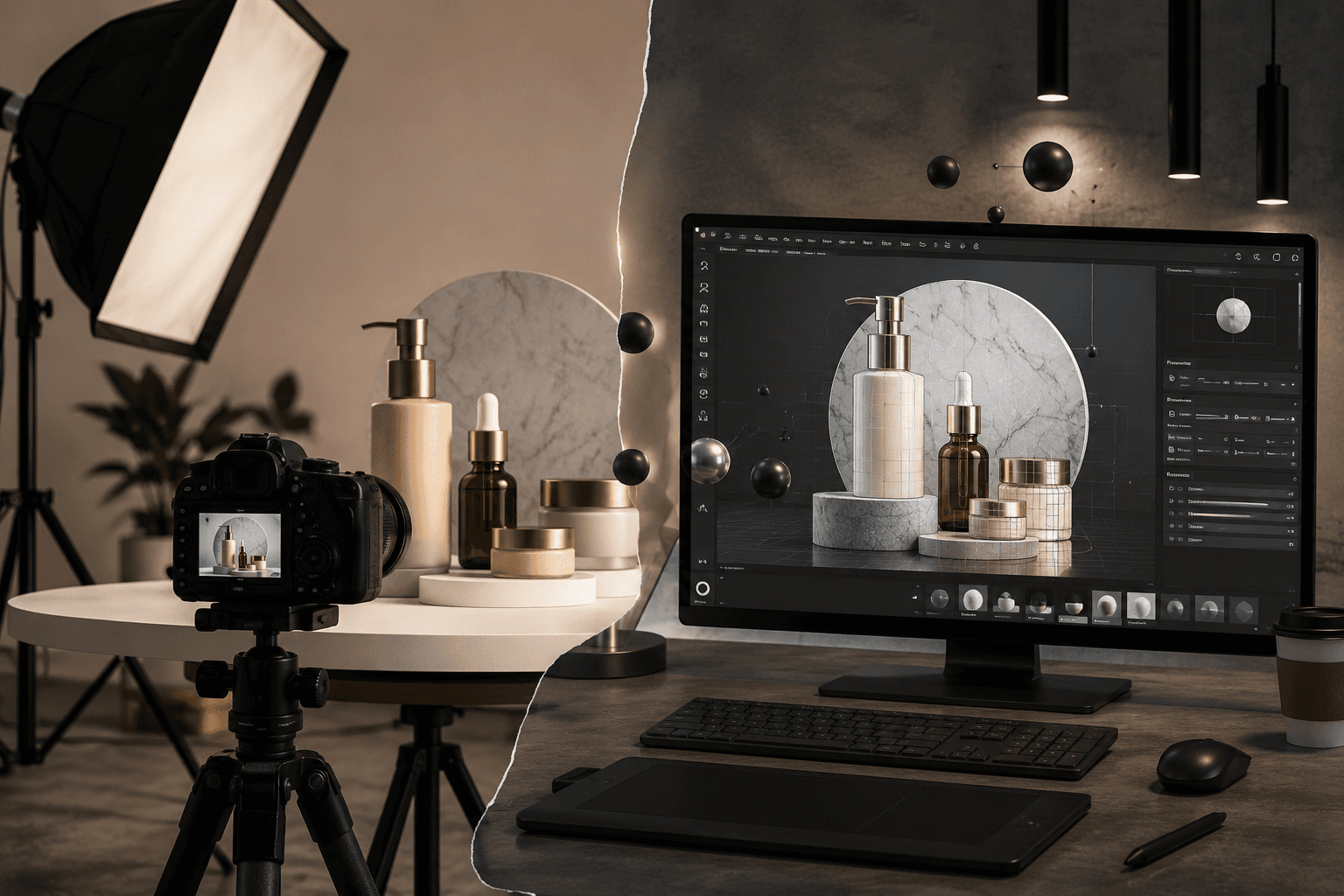
Product rendering services are the process of creating photorealistic product images using 3D modeling and CGI (Computer Generated Imagery) software — without any physical camera, studio, or lighting setup.
A skilled 3D artist builds a precise digital replica of your product, places it in a virtual environment with accurate lighting and textures, and renders it into a final image or animation that looks indistinguishable from a real photograph.
Today, product rendering services cover a wide range of deliverables including:
Silo/white background renders for Amazon and Flipkart listings
Lifestyle product renders for Shopify and social media
360-degree product views for interactive e-commerce pages
A+ content images for enhanced Amazon brand pages
Exploded view renders for technical or instructional content
3D product animation for ads and social campaigns
Brands using professional CGI product rendering services are no longer limited by what's physically possible on a set. The digital canvas is infinite.
The Problem With Traditional Product Photography
Before exploring why product rendering services win, it's worth understanding what's broken about the traditional approach.
A typical product photoshoot involves studio booking, equipment hire, a photographer, stylists, props, product shipping, multiple shooting sessions, and weeks of post-production editing. For a brand with 50 SKUs across 4 color variants, that's 200 individual product configurations to photograph — each requiring its own setup.
The costs spiral fast. The timelines stretch. And the moment a product gets a packaging update or a new variant launches, the entire process starts again.
Traditional photography also introduces inconsistency. Lighting changes between shoots. Different photographers have different styles. Products photographed six months apart rarely look identical side by side — which weakens brand identity at scale.
Product rendering services solve all of this at the root level.
Top 10 Reasons to Switch to Product Rendering Services
Reason 1: Cut Production Costs by Up to 70%
One of the most compelling advantages of 3D product rendering is the dramatic reduction in production costs. Traditional photoshoots carry fixed overhead — studio rental, crew, lighting rigs, travel, and post-processing — regardless of how many images you actually use.
With CGI product rendering services, you pay to build the 3D model once. After that, every angle, background change, color variant, and scene is generated digitally at a fraction of the original cost. Brands with large catalogs see savings of 60–70% on their visual production budget within the first year of switching.
For growing e-commerce brands, that's budget redirected toward marketing, inventory, or customer acquisition.
Reason 2: Faster Turnaround Without Compromising Quality
Speed is currency in e-commerce. Getting a new product listed quickly — with high-quality images — directly impacts revenue. Traditional photoshoots can take 2 to 4 weeks from scheduling to final delivery. CGI product rendering services compress that timeline significantly.
At SMAPIT, a standard product image stack of 7 to 9 images per SKU is delivered within 3 to 5 business days from brief sign-off. Rush timelines are available for product launches with tight deadlines.
Faster images mean faster listings. Faster listings mean faster sales.
Reason 3: Unlimited Creative Flexibility
Traditional photography is constrained by the physical world. You need the actual prop, the actual location, the actual setup. If you want your product photographed in a Scandinavian kitchen or against a Dubai skyline at sunset, you either pay for that location or settle for a less compelling shot.
CGI product rendering removes every physical constraint. Any environment, any lighting condition, any composition — created entirely in software. This gives brand creative directors the freedom to execute their vision exactly as imagined, without logistical compromise.
Seasonal campaigns, product launches, A/B testing different lifestyle scenes — all become dramatically easier and more affordable.
Reason 4: Perfect Consistency Across Every SKU
Brand consistency is one of the most underrated conversion factors in e-commerce. When a customer browses your product catalog, every image should feel like it belongs to the same visual universe — same lighting, same angle, same quality.
With traditional photography, consistency is nearly impossible to maintain at scale. Studio conditions vary. Photographers change. Products photographed in different seasons look different.
3D product rendering services work from a single standardized setup. Every SKU, every variant, every platform gets the same lighting model, the same render settings, the same output quality. The result is a visually cohesive catalog that builds trust and reinforces brand identity.
Reason 5: Scale Your Catalog Without Extra Shoots
For e-commerce brands expanding their product range, the prospect of photographing every new SKU is a genuine bottleneck. CGI eliminates that bottleneck entirely.
Once a 3D master model exists for a product, generating new variants is straightforward. A new color? Change the material in software. A new size? Adjust the model dimensions. A new packaging design? Update the texture file. None of these changes require a new photoshoot.
Brands using product rendering services can scale their visual catalog as fast as they scale their product range — without proportional increases in photography cost or time.
Reason 6: Platform-Ready Visuals From Day One
Every major e-commerce platform has specific image requirements. Amazon requires a pure white background (RGB 255,255,255), a minimum image size of 1000px on the longest side, sRGB color profile, and JPEG format for main listing images. Shopify, Flipkart, and social platforms each have their own specifications.
Professional product rendering services produce images formatted to these requirements from the outset. There's no back-and-forth with a retoucher to fix backgrounds or adjust dimensions. SMAPIT's renders are delivered Amazon-compliant, platform-ready, and optimized for both desktop and mobile display from the first delivery.
Reason 7: Future-Proof With AR and 360-Degree Views
Augmented Reality (AR) and interactive 360-degree product views are fast becoming expected features on premium e-commerce listings. Shoppers want to visualize how a sofa looks in their living room or how a skincare bottle sits on their bathroom shelf — before they buy.
These experiences are built on the same 3D assets that power your product renders. When you invest in CGI product rendering services, you're not just getting static images — you're building a 3D asset library that can power AR try-on, interactive 360° viewers, and immersive brand experiences well into the future.
Traditional photography cannot deliver this. CGI can.
Reason 8: No Physical Product Required
This is a game-changer for pre-launch campaigns. With traditional photography, you need a finished, market-ready product before you can create a single image. That means no visuals during development, no pre-launch marketing assets, no early listing creation.
3D product rendering services can begin as soon as you have a technical drawing, CAD file, or detailed brief. SMAPIT has produced complete Amazon listing image stacks for products still in manufacturing — enabling brands to build their listing, run pre-launch ads, and generate early demand before the product physically exists.
For product launches, this is a significant competitive advantage.
Reason 9: Easier Iteration and Version Control
In traditional photography, making changes after a shoot is expensive. A retoucher can fix minor flaws, but structural changes — a different background, a moved prop, a reframed angle — often mean a reshoot.
With CGI product rendering, iterations are part of the workflow. Change the background color, reposition the product, adjust the lighting mood, try a different camera angle — all within the 3D file, at a fraction of the cost of a reshoot.
This makes A/B testing visual creatives genuinely practical for the first time. Brands can test two lifestyle backgrounds, two lighting setups, or two compositions — and optimize their listing images based on real conversion data.
Reason 10: Higher Conversions and Better ROI
Ultimately, every investment in product visuals should be measured against one metric: does it drive more sales?
The evidence for CGI is compelling. Amazon's own data shows that A+ content — which relies heavily on high-quality product renders — can increase conversion rates by up to 8%. Listings with more images, higher image quality, and lifestyle context consistently outperform listings with basic photography.
When you combine the cost savings of CGI product rendering services with the conversion uplift from better visuals, the return on investment is clear. Brands aren't just spending less on photography — they're getting more revenue per visual dollar spent.
CGI Product Rendering vs Traditional Photography: Quick Comparison
Factor | CGI Product Rendering | Traditional Photography |
|---|
Cost | 60–70% lower at scale | High fixed costs per shoot |
Turnaround | 3–5 business days | 2–4 weeks |
Consistency | Perfect across all SKUs | Variable between shoots |
Scalability | Unlimited from one 3D model | Requires new shoot per variant |
Creative freedom | Unlimited environments | Limited to physical sets |
AR/360° ready | Yes, built-in | No |
Pre-launch visuals | Yes | No |
Platform compliance | Built-in | Requires retouching |
Who Should Use Product Rendering Services?
Product rendering services deliver the highest value for:
E-commerce brands on Amazon, Flipkart, or Shopify managing 10 or more SKUs who want faster, more consistent listings without ongoing photography costs.
DTC brands building a strong visual identity and wanting lifestyle imagery that reflects a specific aesthetic or brand world.
Product startups who need marketing visuals before their product is physically ready for a shoot.
Established brands refreshing their catalog who want to update existing listing images without the cost and disruption of a full reshoot.
Agencies and brand managers handling multiple client catalogs who need a reliable, scalable visual production partner.
How SMAPIT Delivers World-Class Product Rendering
SMAPIT is a CGI and 3D visualization studio headquartered in Gurugram, India, with operations serving brands across India, the United States, and the UAE. With 4+ years of 3D production expertise and an AI-powered production pipeline, SMAPIT delivers photorealistic product renders trusted by 50+ brands including Agaro, Mivi, Luminous, and LuvLap.
Their product rendering services include:
White background silo renders — Amazon-compliant, pixel-perfect
Lifestyle product renders — real-world scene integration
A+ content image sets — mobile-first, module-ready
Infographic panels — feature callouts and scale references
360-degree and AR-ready assets — for immersive shopping experiences
3D product animations — for ads, reels, and campaign content
Standard delivery: 7–9 images per SKU within 3–5 business days.
👉 Explore SMAPIT's Product Rendering Services
FAQs About Product Rendering Services
Are CGI product images allowed on Amazon?
Yes. Amazon explicitly permits CGI and 3D rendered images on product listings, provided they accurately represent the product. SMAPIT produces all renders to Amazon's full compliance specifications.
How realistic do CGI product renders look?
Modern CGI product rendering is photorealistic to the point where most consumers cannot distinguish rendered images from photographs. SMAPIT uses industry-leading rendering software to achieve that level of quality.
What do I need to provide to get started?
SMAPIT can work from product dimensions, reference photographs, CAD files, packaging artwork, or a physical product sample. Their team guides you through the brief process from the first call.
How much do product rendering services cost?
Pricing varies by product complexity, number of SKUs, and deliverables required. Contact SMAPIT for a custom quote and free sample render.
Can I get renders before my product is manufactured?
Yes. SMAPIT regularly produces pre-launch listing images from technical drawings and design files — giving brands a head start on their Amazon listing and marketing assets.
Final Verdict
Traditional photography had its time. For brands operating at any meaningful scale in e-commerce today, the cost, speed, consistency, and creative limitations of physical shoots are simply no longer competitive.
Product rendering services offer a smarter, faster, and more scalable path to the high-quality visuals that drive clicks and conversions. Whether you're building your first Amazon listing or refreshing a catalog of hundreds of SKUs, CGI is the standard that leading brands are moving toward — and it's more accessible than most assume.
SMAPIT makes that transition seamless. From the first 3D model to the final platform-ready image, their team handles the entire visual production pipeline — so your brand shows up looking its best, every time.
👉 Get a Free Sample Render from SMAPIT