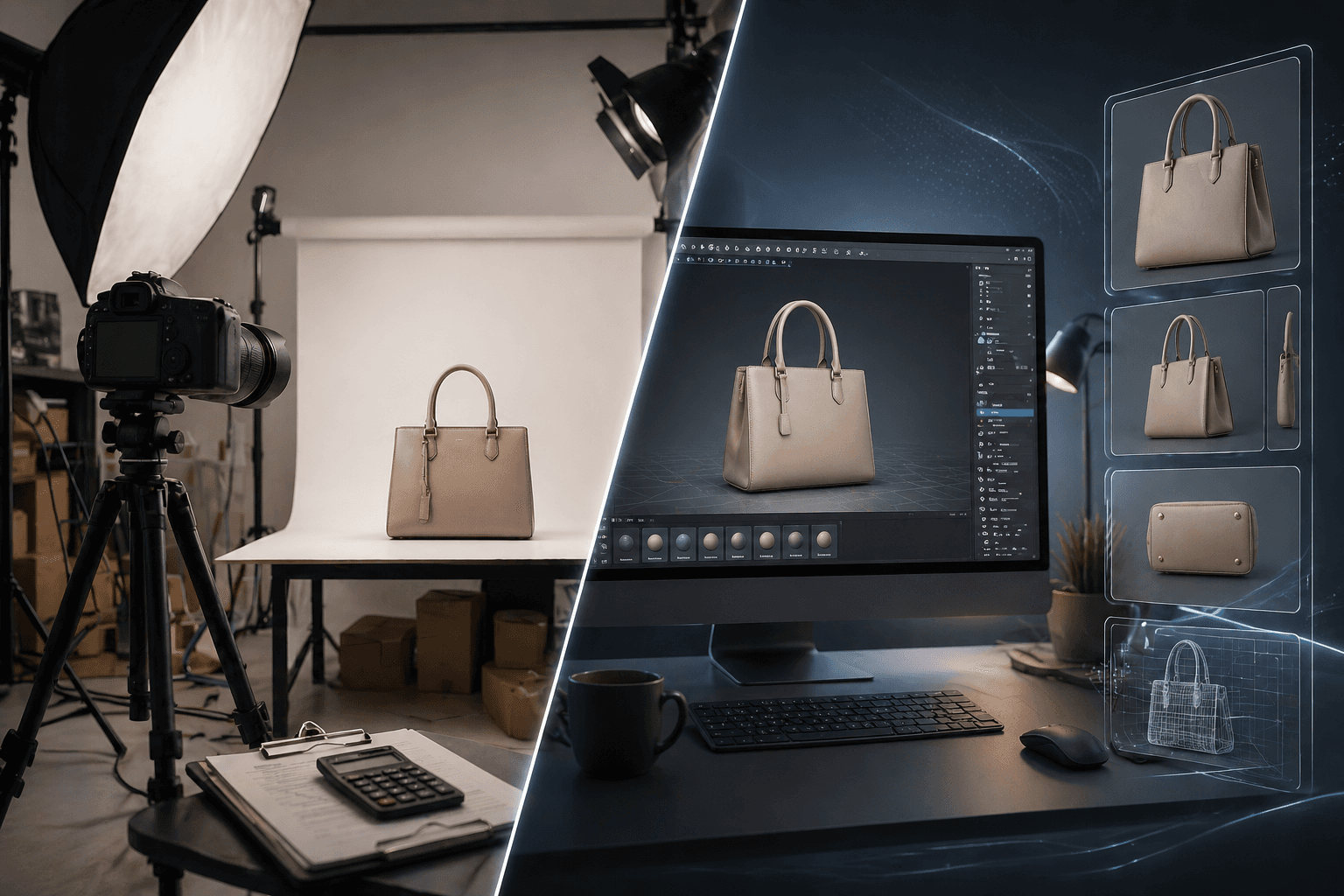
Introduction: The Price Tag You See vs. The Price Tag You Pay
When a brand manager compares traditional product photography with 3D product visualization for the first time, they usually look at one number: the quote from the photographer versus the quote from the 3D studio.
That comparison is almost always misleading.
The photographer's quote covers the shoot day. It does not cover the logistics before it, the retouching after it, the re-shoot when the sample arrives damaged, or the entirely new shoot you will need when you launch a second colourway six weeks later.
3D product visualization pricing, on the other hand, tends to be more complete — and more predictable.
This article does something most studios are reluctant to do: it puts real numbers on both sides, line by line, so you can make a genuinely informed decision about which approach makes sense for your brand at your current scale.
The Anatomy of a Traditional Product Photoshoot
To compare costs fairly, you need to understand what a traditional photoshoot actually involves. Most brands only budget for the visible costs. The hidden costs are what make photography expensive at scale.
Visible costs
Studio rental: A half-day studio hire in a metro city like Mumbai, Delhi, or Bangalore typically runs ₹8,000 to ₹25,000. A full day, which you will almost certainly need if you have more than 5–6 products, doubles that.
Photographer fee: A competent commercial product photographer charges between ₹15,000 and ₹60,000 per day, depending on their experience and the complexity of the brief. This covers shooting time only — not editing.
Stylist and prop costs: For lifestyle shoots or anything beyond a plain white background, you need a prop stylist. Day rates typically start at ₹8,000 and props are either rented (₹5,000–₹20,000 per shoot) or purchased and written off.
Post-production and retouching: Retouching is almost never included in the photographer's day rate. Expect ₹500 to ₹2,000 per image for professional retouching — more for complex clipping paths, background replacements, or color corrections.
Hidden costs
Sample logistics: Your product has to physically reach the studio and return safely. Shipping, packaging, and insurance for fragile or high-value items can add ₹3,000 to ₹15,000 per shoot, plus the time and coordination overhead.
Sample damage or loss: It happens more than brands like to admit. A broken sample means a re-shoot, which means rebooking the studio, the photographer, and the stylist — and paying all those costs again.
Variant shoots: If your product comes in four colors, you either shoot all four on the same day (which compresses your shot list and raises complexity) or you book separate shoots. Neither option is free.
Revisions and reshoots: Client requests a different angle. The art director wasn't on set. The product packaging was the pre-production version. Each of these scenarios means going back — and each costs nearly as much as the first shoot.
Internal coordination time: Someone at your company is managing the photographer, the studio, the courier, the sample approval, the retoucher, and the file delivery. That person's time has a real cost that never appears on a creative invoice.
The Real Per-SKU Cost of Photography: A Worked Example
Let's say you are launching a new skincare range with 8 products, each shot in 5 angles on a white background plus one lifestyle image — a modest brief by any standard.
Cost item | Amount |
|---|
Studio (full day) | ₹20,000 |
Photographer fee | ₹35,000 |
Retouching (48 images @ ₹1,200) | ₹57,600 |
Sample logistics (both ways) | ₹6,000 |
Styling and props | ₹12,000 |
Project coordination (internal, 2 days) | ₹8,000 |
Total | ₹1,38,600 |
Cost per SKU | ₹17,325 |
Cost per image | ₹2,888 |
That is before any re-shoots, before you add a second colourway, and before you brief a separate photographer for your social media content.
The Anatomy of 3D Product Visualization Costs
3D product visualization has its own cost structure — but it is structured differently. The significant investment happens once, at the modeling stage. Everything after that is incremental.
One-time cost: 3D modeling
Building the 3D model of your product is the core investment. For a standard consumer product — a bottle, a box, a small appliance — professional modeling costs between ₹3,000 and ₹12,000 per SKU depending on complexity. A complex product with many components (a multi-part skincare set, a mechanical product) sits at the higher end.
This is the only cost you pay once. Every render you ever produce from that model draws on this asset without rebuilding it.
Recurring cost: rendering
Each rendered image — a specific angle, background, or lighting setup — costs between ₹800 and ₹3,000 depending on complexity. Lifestyle composites (product placed in a scene) are slightly higher.
Applying this to the same brief
8 skincare products, 5 white background angles each, 1 lifestyle composite each:
Cost item | Amount |
|---|
3D modeling (8 SKUs @ ₹7,000 avg) | ₹56,000 |
White background renders (40 @ ₹1,200) | ₹48,000 |
Lifestyle composites (8 @ ₹2,500) | ₹20,000 |
Total | ₹1,24,000 |
Cost per SKU | ₹15,500 |
Cost per image | ₹2,583 |
Already marginally cheaper — and that comparison does not yet account for what happens next.
Where the Difference Becomes Dramatic: Scale and Iteration
The comparison above makes 3D look like a modest saving on a single project. The real story is what happens when you grow.
Adding a new colourway
Photography: Book studio again. Reship samples. Book photographer again. Pay retoucher again. Minimum cost: ₹40,000–₹70,000.
3D visualization: Apply new material to existing model. Re-render. Cost: ₹800–₹2,000 per image.
Adding a new angle or background
Photography: Impossible without a re-shoot if the session is closed.
3D visualization: Load model, adjust camera or environment, render. Cost: ₹800–₹2,000.
Launching 50 SKUs instead of 8
At 50 SKUs, most brands find that traditional photography becomes logistically unmanageable — not just expensive. Coordinating samples, scheduling shoots, and managing delivery timelines for 50 products simultaneously is a full-time operation.
3D visualization at that scale is a production pipeline. Models are queued, rendered in parallel, and delivered on a schedule. The cost per image typically decreases with volume.
The Time Cost: Often Bigger Than the Money Cost
Ecommerce brands operate on launch calendars. A product that is delayed two weeks at the photography stage costs not just money — it costs the seasonal window, the ad spend that was already committed, and the first-mover advantage in a competitive category.
Typical photography timeline:
Sample preparation and approval: 3–7 days
Studio booking lead time: 5–14 days
Shoot day: 1–2 days
Retouching and delivery: 3–7 days
Total: 12 to 30 days
Typical 3D visualization timeline:
Brief and asset handover: 1–2 days
3D modeling: 2–5 days
First proofs for approval: within 48 hours of modeling completion
Revisions and final delivery: 1–3 days
Total: 4 to 10 days
For a brand launching on a deadline, that three-week difference is not a minor convenience — it is a material business advantage.
When Traditional Photography Still Makes Sense
This article is not arguing that photography is obsolete. There are specific scenarios where it remains the right choice:
Highly tactile materials. Raw denim, hand-thrown ceramic, rough-hewn leather — materials where the tactile imperfection is the point. Photorealistic 3D rendering can replicate these, but it requires a high level of artistry and the result may still lack the organic authenticity of a real photograph.
Food and beverage. Liquid movement, condensation, steam, and the natural imperfection of a plated dish are extremely difficult to simulate convincingly in 3D. Food photography remains largely a physical discipline.
Hero campaign shots. For a major brand campaign where the image will run full-page and the art direction is highly specific, an experienced photographer on location can produce something that CGI — despite being photorealistic — does not replicate in terms of creative vision and atmosphere.
For everything else — catalogue images, marketplace listings, variant renders, background changes, pre-launch content, social media assets — 3D visualization is now the more practical choice for the majority of ecommerce brands.
Frequently Asked Questions
Is 3D visualization actually cheaper than photography for a small product catalogue?
For fewer than 5 SKUs with no variants, costs are comparable. The advantage of 3D starts to compound from around 8–10 SKUs, and becomes significant at 25 or more.
What if I don't have a CAD file for my product?
3D modeling from reference photographs is standard practice. It adds slightly to modeling time compared to working from a CAD file, but is perfectly achievable for most product types. Alternatively, shipping a physical sample to the studio allows the modeler to measure and replicate the product accurately.
Can the 3D model be reused for animation or interactive content later?
Yes — this is one of the strongest arguments for investing in quality 3D modeling. A well-built model can generate still images, 360-degree spin videos, explainer animations, CGI ad creatives, and interactive web configurators from the same source asset.
How do I know if a 3D render is good enough quality for Amazon or Flipkart?
Ask the studio for examples of renders that have been approved and live on those platforms. At Smapit, we deliver renders that meet Amazon's technical requirements (minimum 1000px on the longest side, pure white background at 255,255,255 for hero images) as a baseline standard.
The Decision Framework
Before your next product content brief, run through these four questions:
How many SKUs are you shooting? If it is more than 10, 3D visualization is almost certainly more cost-efficient.
Do you have variants (colour, size, material)? If yes, the economics of 3D become compelling immediately.
Do you have a physical product ready? If not, 3D lets you produce content before the product exists — photography cannot.
Will this content need to be updated or extended? If yes, the reusable 3D asset is worth its weight.
If you answered yes to any of those questions, a conversation with a 3D visualization studio is worth your next 30 minutes.
Conclusion
The comparison between traditional photography and 3D product visualization is not really about which produces a better-looking image. At professional quality levels, both can produce exceptional results.
The comparison is about scalability, speed, cost predictability, and operational flexibility — and on all four dimensions, 3D visualization wins for the majority of ecommerce brands operating at any meaningful scale.
The brands switching to 3D are not doing it because it is trendy. They are doing it because the numbers make sense, the timelines are faster, and the creative flexibility is genuinely broader than what a photography studio can offer.
Explore Smapit's 3D product visualization and ecommerce content services at smapit.in. Our team works with brands across beauty, electronics, furniture, and FMCG to replace photoshoots with scalable 3D production pipelines.