The United States is home to 50% of all ecommerce websites globally. Shopify powers 29% of them — over 4 million active stores, from solo founders selling their first product to eight-figure brands running multi-channel operations across DTC, Amazon, and wholesale.
The Shopify brands that are scaling fastest in 2026 have quietly stopped booking photoshoots. Not because they can't afford them. Because they've done the math and realized that a CGI pipeline outperforms a photography pipeline on every metric that actually drives growth — speed, cost, creative volume, consistency, and conversion.
This is the shift happening across US ecommerce right now. Here is what is driving it, what it looks like in practice, and how your Shopify brand can build the same infrastructure.
The Shopify Brand's Creative Problem in 2026
Running a Shopify brand in the US in 2026 is a visual content arms race. The channels your brand needs to be active on — your own site, Amazon, social media, paid ads on Meta and Google, email, influencer content — all demand product imagery. Not the same image reused everywhere. Fresh, channel-appropriate, on-brand visuals that perform in each specific context.
The math breaks fast. A photoshoot produces a fixed set of images in a fixed timeframe at a fixed cost. It cannot scale with your channel mix, your SKU count, or your campaign frequency. Every new product launch, every seasonal refresh, every new ad creative test requires either a new shoot or settling for repurposed content that underperforms.
The smartest Shopify brands in the US have identified this as a structural bottleneck — not a creative problem, not a budget problem, but a production infrastructure problem. And CGI is the infrastructure fix.
What CGI Actually Means for a Shopify Brand
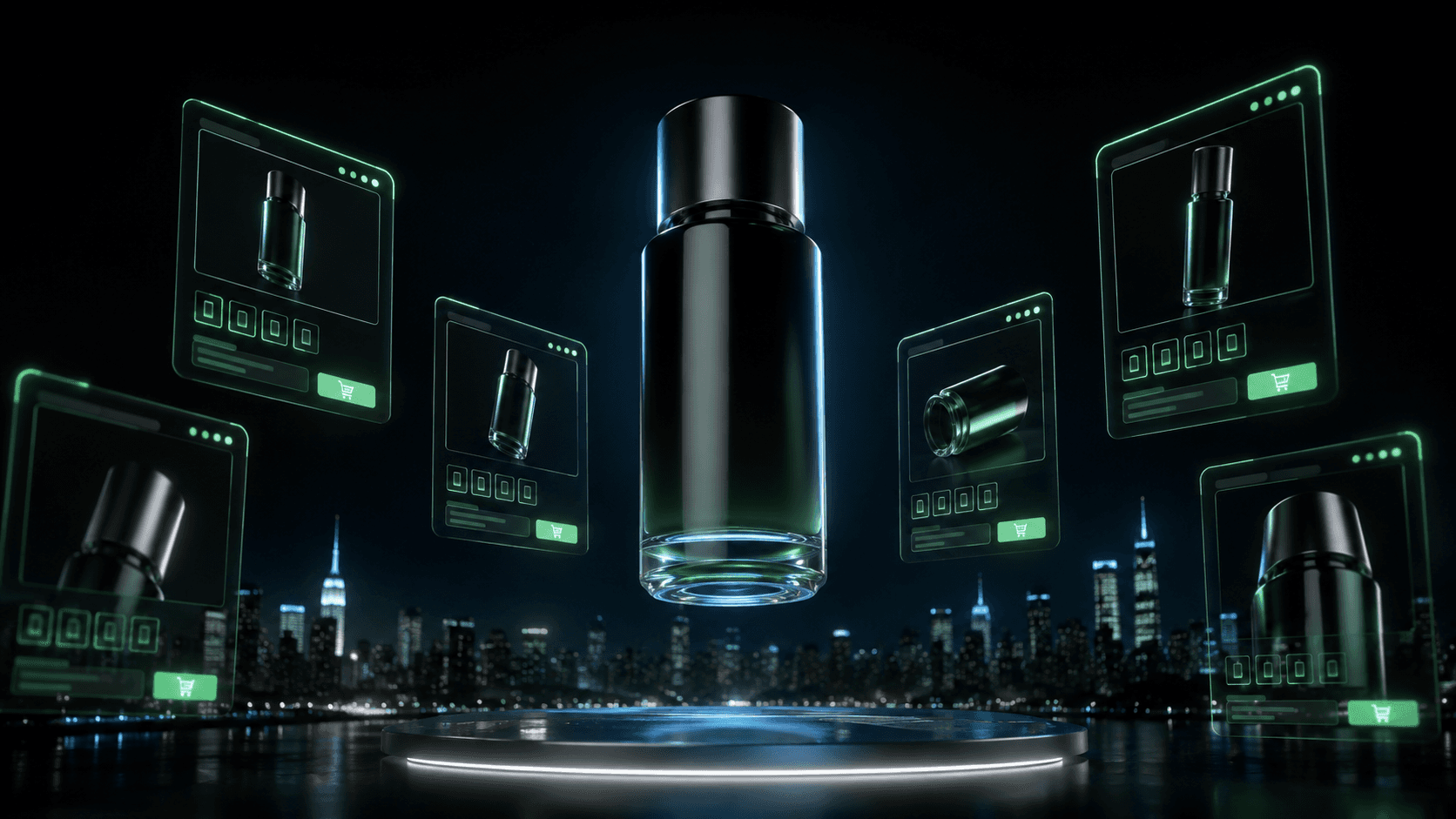
CGI in the context of a Shopify DTC brand means building a 3D model of your product once and using it as the master asset for every visual your brand needs — forever.
Your product detail page images come from it. Your Amazon listing images come from it. Your Meta ad creative comes from it. Your email header comes from it. Your seasonal campaign visuals come from it. Your TikTok product reveal comes from it. Every piece of visual content across every channel, for every campaign cycle, from a single 3D asset that never expires, never needs reshooting, and gets cheaper to use with every additional render you produce from it.
This is not a marginal efficiency improvement over photography. It is a fundamentally different production model — one that scales with your brand instead of forcing your brand to scale around its production limitations.
6 Ways CGI Is Giving US Shopify Brands a Real Competitive Edge
1. Launch Products Before They Physically Exist
This is the capability that consistently surprises Shopify brand founders when they first encounter it. CGI works from CAD files, product specs, and packaging dielines — not from a finished physical product. You do not need inventory in hand to produce launch-ready product imagery.
For a US Shopify brand, this means your product page can be live, your pre-launch ads can be running, your influencer seeding can be happening, and your email list can be building — all while your product is still being manufactured overseas. By the time stock lands in your warehouse, you already have conversion data, early reviews from pre-orders, and an audience warmed up and ready to buy.
Photography cannot do this. CGI can. And in a market where launch momentum is built in the weeks before a product ships, this capability is a genuine competitive edge that compounds with every product launch.
2. Scale SKUs Without Scaling Shoot Costs
The economics of photography are brutal at SKU scale. Every new product variant — new color, new size, new formulation, new flavor — requires a new shoot. The cost per SKU does not decrease as your catalog grows. It stays flat or increases as logistics and coordination complexity grows with it.
CGI breaks this model completely. Once your product is modeled in 3D, producing a new color variant is a material value change and a re-render. A new size variant is a geometric adjustment and a re-render. A new seasonal packaging is a label swap and a re-render. The marginal cost of adding the fifteenth SKU to your CGI catalog is a fraction of what the first SKU cost to model.
For Shopify brands expanding their product range — which is the growth path for almost every successful DTC brand — CGI is the production infrastructure that makes catalog scaling economically sustainable.
3. Produce Campaign Creative at the Volume Paid Ads Actually Need
US Shopify brands running paid social on Meta and TikTok know the problem intimately — the creative is the variable that moves performance more than any other lever. Better creative means lower CAC. Finding better creative means testing more variants. Testing more variants means producing more variants.
Photography budgets cap your creative testing volume. A typical Shopify brand running paid social with a reasonable photography budget might produce eight to twelve new creative assets per month. That volume is not enough to run meaningful creative tests across multiple ad sets, multiple audiences, and multiple campaign objectives simultaneously.
CGI from an existing 3D model produces ten to twenty creative variants in the same timeframe at a fraction of the marginal cost. Different backgrounds. Different lighting treatments. Different lifestyle contexts. Different camera angles. Different motion treatments for video formats. The creative testing volume that actually drives paid performance becomes accessible — and the brands that find their winning creative fastest are the ones that scale their spend most efficiently.
4. Maintain Visual Consistency Across Every Channel
A Shopify brand's visual identity lives across a lot of surfaces simultaneously — the product detail page, the collection page, the homepage hero, the email header, the Meta feed ad, the TikTok creative, the Amazon listing, the wholesale line sheet. Maintaining a consistent visual language across all of these with photography is genuinely difficult — different shoot sessions produce subtle but visible variations in lighting, color treatment, and composition.
CGI produces pixel-perfect consistency across every channel, every format, and every campaign because every image comes from the same 3D model under controlled conditions. The product looks identical on your Shopify PDP, your Amazon listing, and your Meta ad — same color accuracy, same material rendering, same visual quality. That consistency is a brand trust signal that customers register at a subconscious level, and it directly affects purchase confidence.
5. Reduce Returns With Imagery That Sets Accurate Expectations
US ecommerce return rates average 17.6% across categories, with some verticals running significantly higher. A disproportionate share of returns are driven by product imagery that did not accurately represent what the customer received — wrong color perception, unexpected material quality, size misrepresentation.
CGI built from precise product specifications sets accurate visual expectations consistently. The color is exact. The material finish renders as it actually appears. The scale relationships are correct. Customers who receive exactly what the imagery led them to expect return at dramatically lower rates.
For Shopify brands where returns eat directly into margin — particularly in fashion, beauty, and home categories where return rates run highest — the reduction in expectation-mismatch returns from accurate CGI imagery is a direct financial benefit that compounds with every order.
6. Repurpose One 3D Asset Across Every Platform Format
Shopify brands in the US operate across a fragmented platform landscape — their own site, Amazon, social commerce on Instagram and TikTok, Google Shopping, Pinterest, email. Each platform has different image format requirements, different aspect ratios, different file size limits, and different creative best practices.
With photography, adapting a single image set to every platform format means cropping, reformatting, and frequently losing quality in the process. With CGI, the same 3D model renders in any format required — 1:1 for Instagram feed, 9:16 for Stories and TikTok, 16:9 for YouTube, 1200x628 for Google Display, pure white square for Amazon. Platform-native formats from a single asset brief, without cropping or quality loss.
What the Numbers Say About CGI vs Photography for Shopify Brands
The performance data behind CGI for ecommerce is not ambiguous. Products with 3D and CGI content convert at 94% higher rates than those using only traditional 2D photography, according to Shopify's own platform data. Brands using comprehensive CGI imagery report return rate reductions of up to 40%. And the creative testing volume that CGI enables consistently produces paid ad winning creatives faster — which translates directly to lower cost per acquisition and higher return on ad spend.
For a Shopify brand scaling from $500K to $2M in annual revenue — the growth stage where operational efficiency becomes as important as top-line growth — CGI is the production infrastructure that removes the bottleneck holding back creative output and paid performance simultaneously.
The SMAPIT Advantage for US Shopify Brands
SMAPIT is an AI-powered 3D product visualization studio that works with US Shopify brands from our production base in India. This setup is not incidental — it is a deliberate structural advantage for the brands we work with.
US-based 3D visualization studios charge US market rates. A comparable CGI project in the US costs two to four times what SMAPIT charges for equivalent or superior output quality. The time zone difference works in your favor too — briefs submitted at end of business US Eastern time come back to you with progress updates by the start of the next business day.
Our AI-enhanced production pipeline means faster turnaround than traditional CGI studios — a complete product image set in three to seven business days, with lifestyle composites and variant libraries in the same window. And our 4+ years of ecommerce product visualization experience means we understand what imagery needs to do commercially — not just what it needs to look like technically.
For US Shopify brands that have been treating their production pipeline as a cost of doing business rather than a competitive variable, the switch to CGI through SMAPIT is the kind of operational upgrade that changes growth trajectories.
How to Start Your CGI Pipeline as a Shopify Brand
The practical starting point is simpler than most brands expect.
Start with your highest-revenue product or your next launch — whichever comes first. Commission a 3D model of that product. Use it to produce your full image set — main packshot, multiple angles, lifestyle composite, and ad creative variants. Run those assets across your channels and measure performance against your existing photography.
The data from that first project tells you everything you need to know about the value of scaling the approach across your catalog. Most brands that run this test don't go back to photography for new products.
The 3D model you build for your first product is a permanent asset. Every render from it — for every future campaign, every seasonal refresh, every new platform requirement — is a fraction of the original production cost. The CGI library you build now is the visual production infrastructure your brand runs on for years.
Frequently Asked Questions
Can CGI product images be used on a Shopify storefront? Yes. CGI renders are delivered as standard image files — JPEG, PNG, WebP — that integrate directly with any Shopify theme. CGI images are used by Shopify brands across every category on their product detail pages, collection pages, and homepage features.
Do US Shopify brands need to ship products to SMAPIT for CGI production? No. SMAPIT works from product samples, CAD files, packaging dielines, and detailed reference photography. Physical samples can be shipped for material reference but are not required to begin production. The entire production process is managed remotely.
How does CGI compare to photography for Shopify conversion rates? Shopify's own platform data shows that products featuring 3D and CGI content convert at 94% higher rates than products using only traditional 2D photography. The improvement is driven by better angle coverage, higher material accuracy, lifestyle context, and the premium brand perception that quality CGI creates.
What is the turnaround time for CGI product images for a US Shopify brand? Standard turnaround from SMAPIT is three to seven business days for a new product including 3D modeling and a complete image set. Repeat productions from existing 3D models deliver in two to three business days. The time zone difference between the US and India means briefs submitted at end of US business day return with progress by the following morning.
Is CGI affordable for early-stage US Shopify brands? Yes. SMAPIT's production base in India means pricing is significantly below equivalent US-based studio rates — delivering comparable or superior output at two to four times lower cost. For Shopify brands at the $250K to $2M annual revenue stage, CGI is cost-competitive with professional photography for hero products and significantly more economical at catalog scale.
How does a Shopify brand get started with CGI at SMAPIT? The fastest path is to send your product reference — a physical sample, a CAD file, or detailed reference photography — along with your creative brief. SMAPIT will provide a clear quote, a timeline, and a production plan before any work begins.