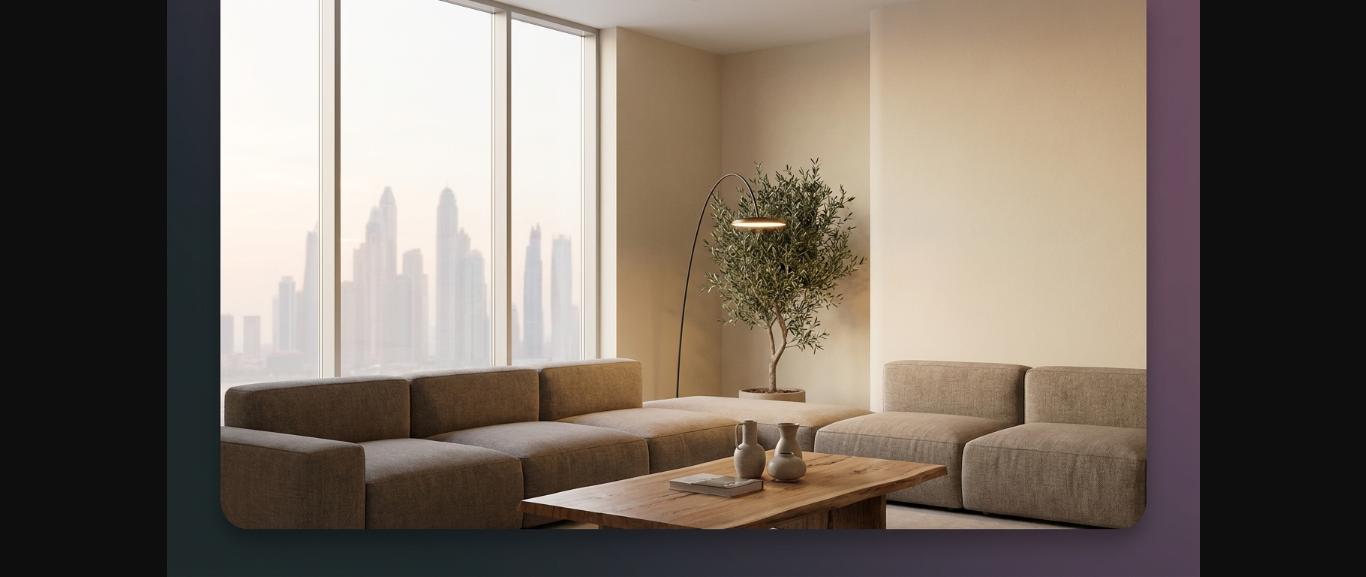
The UAE home furniture market is worth 2.9 billion dollars in 2026 and is projected to grow to 3.55 billion dollars by 2031. Ecommerce furniture sales in Abu Dhabi grew 41 percent between 2021 and 2023, while Dubai grew 23 percent over the same period. Both numbers are being driven by the same force: a wave of residential handovers across Dubai and Abu Dhabi that is putting more new homes into the market than at almost any point in the last decade.
Every one of those new homes needs furniture, and the brands selling to them face a production problem that other ecommerce categories do not. Furniture is bulky, expensive to ship to a studio, and sold almost entirely on how it looks inside a finished room rather than on a plain background. A sofa on white does not sell a sofa. A sofa in a living room does.
Dubai furniture and home brands are solving this with CGI, because CGI is the only production method that can generate a complete room set, in every finish and every configuration, without moving a single physical piece into a studio.
Why Furniture Is Uniquely Hard to Photograph
Furniture photography carries production costs that most other ecommerce categories do not face at all.
The Warehouse and Studio Logistics Problem
A sofa, a dining table, or a wardrobe has to be transported from a warehouse to a studio, assembled, styled, shot, disassembled, and returned. For a brand with even a modest catalog, that logistics cycle repeats dozens of times, and every trip adds freight cost, handling risk, and scheduling delay. A single damaged corner or a scuffed finish during transport can knock a SKU out of a launch entirely.
CGI removes the physical movement from the process altogether. A 3D model is built once from reference dimensions and material specifications, and every subsequent render, every color, every room setting, comes from that same digital asset with no warehouse trip required.
Room Sets Need Context Photography Cannot Scale
Furniture buyers do not evaluate a single product in isolation. They evaluate how a sofa looks against a specific wall color, how a dining set fills a specific room size, how a wardrobe finish reads under specific lighting. Photography can produce one or two styled room sets per product if the budget allows for a full set build. CGI can produce that same product in ten different room contexts because the room itself is also a digital asset that gets reused across the entire catalog.
Ways CGI Changes Production for Dubai Furniture Brands
Room Sets Without a Physical Staging Budget
A styled photography set for a single room can cost more than an entire month of furniture photography for a smaller brand, once props, styling, and location or studio rental are included. A CGI room set is built once and reused indefinitely, with lighting, camera angle, and styling adjusted per product without rebuilding the physical space.
Every Material and Finish Variant From One Model
A sofa sold in eight fabric options needs eight accurate representations of exactly how that fabric looks under real light. CGI produces all eight from a single 3D model with material swaps, while photography needs eight physical samples in eight studio sessions, assuming all eight fabric runs exist before the shoot date.
Hospitality and Real Estate Staging Renders at Scale
Dubai's hospitality boom and residential handover wave has created a second market for furniture brands: developers and hospitality groups who want to see a brand's catalog staged inside their own unit layouts before committing to a bulk order. CGI can place a brand's furniture catalog inside a developer's actual floor plan, a capability photography cannot offer at any reasonable cost.
Swatch Accuracy That Reduces Fit and Finish Returns
Furniture returns are expensive to process, involving freight, restocking, and often a full replacement rather than a simple exchange. A wood finish that reads lighter online than in person, or a fabric texture that looks smoother in a photograph than it feels in a showroom, drives a meaningful share of those returns. CGI material rendering reproduces the actual color and texture specification of a finish rather than a photograph's interpretation of it under one lighting setup.
Catalog Speed That Matches a Multi SKU Launch Calendar
Furniture and home brands frequently launch collections rather than single products, sometimes twenty or more SKUs at once tied to a seasonal or collection release. CGI produces a full collection launch set, every SKU, every finish, every room context, on a timeline that does not scale linearly with SKU count the way a physical shoot does.
The Handover Boom Angle Furniture Brands Are Underusing
The residential handover wave driving Dubai and Abu Dhabi furniture demand is not a short term spike. It reflects a sustained pipeline of new housing supply that is scheduled years in advance, which means furniture brands can forecast demand timing with more certainty than most ecommerce categories get.
Brands that build their CGI asset library ahead of a handover wave, rather than reacting to it, launch complete room sets and collection catalogs the moment demand arrives instead of scrambling to photograph a launch after the fact. For a category where the buying decision is driven almost entirely by how a piece looks in context, having that context ready before the demand wave hits is a real competitive advantage.
SMAPIT: CGI Built for Dubai Furniture and Home Brands
SMAPIT produces CGI product visualization and room set renders for Dubai and UAE furniture and home brands, built around the realities of this category: bulky products, multiple material variants per SKU, and a buying decision that depends on seeing a piece in context rather than on a plain background.
We build a 3D model once from your product specifications and produce full image sets, room sets in multiple contexts, and every material and finish variant, without a warehouse shoot or a physical staging build. Complete catalog sets are typically delivered in five to ten business days depending on SKU count, with room set reuse across future collections at no rebuild cost.
For Dubai furniture and home brands preparing for the next wave of residential handovers, the conversation starts with your current product specifications and the room contexts your buyers actually shop in.
Frequently Asked Questions
Can CGI accurately represent furniture material and fabric texture?
Yes. CGI rendering uses the product's actual material and color specification to reproduce fabric texture, wood grain, and finish sheen, which typically holds more consistent accuracy across variants than photography, where studio lighting can shift how a texture or finish appears from one session to the next.
How many room set contexts can a single furniture piece be rendered in?
There is no meaningful limit, since the room itself is a reusable digital asset. Brands commonly request three to six room contexts per hero product, covering different styles or price positioning, with additional contexts producible at low incremental cost compared to a physical set build.
Does CGI work for large furniture collections with many SKUs at once?
Yes, and this is one of the strongest use cases for CGI in furniture. A twenty or thirty SKU collection launch can be produced on a single production timeline because every SKU uses the same underlying production pipeline, unlike photography where each additional SKU adds a proportional amount of physical shoot time.
Can SMAPIT render furniture inside a specific room layout, like a developer's floor plan?
Yes. Given accurate floor plan dimensions or reference imagery, a furniture catalog can be rendered inside a specific unit layout, which is commonly used by brands supplying hospitality groups or real estate developers who want to preview a full furniture package before committing to an order.
How does CGI reduce furniture return rates?
A meaningful share of furniture returns are driven by a mismatch between how a color or material looked online and how it looks in person. CGI renders that accurately reproduce material specification under neutral, controlled lighting reduce that expectation gap, which lowers the portion of returns driven by the listing image rather than the physical product.
What does SMAPIT need to start a furniture CGI project?
Product dimensions, material and finish specifications, and reference images or CAD files where available. For collections not yet in production, detailed spec sheets and approved material swatches are sufficient to begin, which allows marketing and catalog assets to be ready before physical inventory arrives.