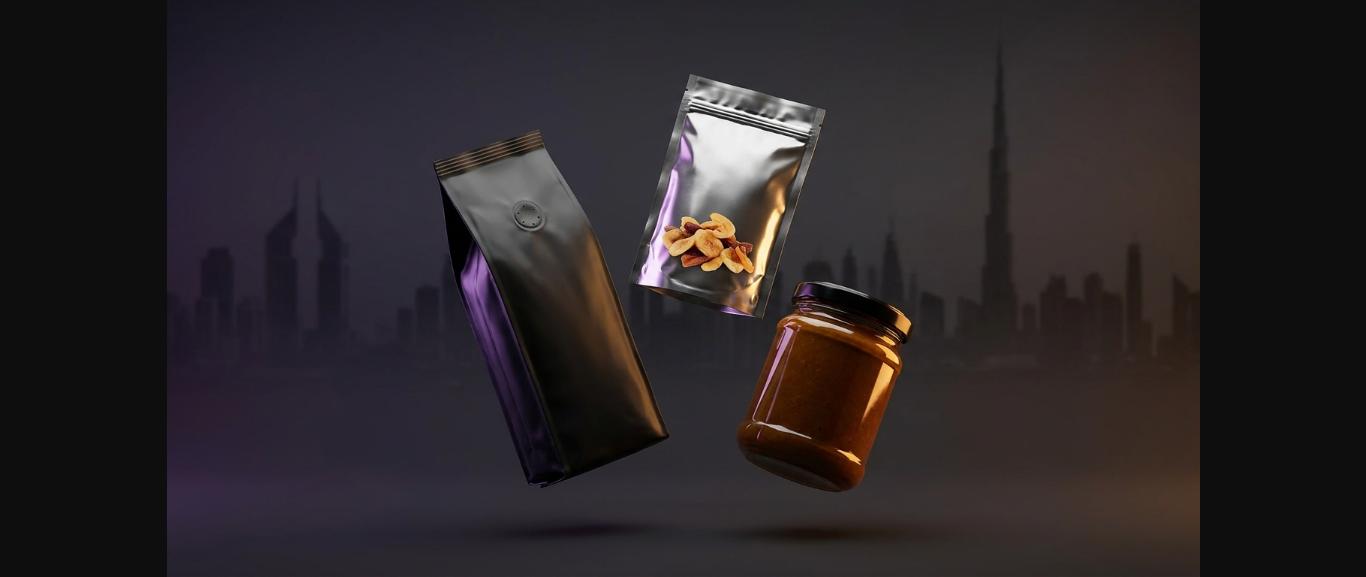
The UAE quick commerce market is worth roughly 187 million dollars in 2026 and is projected to grow to 234 million dollars by 2031. What matters more than the number is the shift underneath it: quick commerce in the UAE has expanded well beyond restaurant delivery into groceries, pharmacy, baby care, and packaged goods, with platforms like Noon Minutes running 15 minute delivery out of dark stores placed near demand hubs.
That shift changes what good product imagery means for F&B and packaged goods brands. A shopper browsing Noon Minutes or Instashop is scrolling a dense grid of small thumbnails, making a decision in seconds, often while distracted. A product photo that looks fine on a brand's own website can disappear into that grid if it was not built for how quick commerce actually displays products.
Dubai F&B and packaged goods brands are solving this with CGI, because CGI produces packaging renders built for thumbnail performance from the first render, and because it handles the SKU and variant complexity that photography struggles to keep up with in a fast moving category.
Why Packaging Photography Fails in a Quick Commerce Grid
Packaging photography has specific failure modes that become obvious the moment a product is competing in a dense, small format grid against dozens of other items.
The Thumbnail Problem for F&B Products
A coffee bag, a snack pouch, or a condiment jar photographed for a lifestyle campaign often loses all of its shelf presence at 150 pixels wide. Reflective foil packaging, glass jars, and matte pouches each reflect studio light differently, and a photography session calibrated for one material type frequently under serves the others in the same catalog. The result is a product grid where some items look premium and others look washed out or flat, purely because of how the packaging material interacted with the studio lighting on the day of the shoot.
Freshness and Variant Complexity
F&B brands typically carry more SKU and flavor variants than almost any other category, and packaging changes more frequently too, driven by limited editions, seasonal flavors, and formulation updates. Photography struggles to keep pace because every variant needs its own physical sample and its own shoot slot, and a fast moving F&B catalog can outrun a photography schedule within a single quarter.
Ways CGI Changes Production for Dubai F&B Brands
Every SKU and Flavor Variant From One Shoot
A snack brand with twelve flavors needs twelve accurate packaging renders. CGI produces all twelve from a single 3D packaging model with label and color swaps, while photography needs twelve physical units in twelve separate setups, assuming all twelve exist as finished packaging samples at shoot time.
Packaging Renders That Hold Up at Thumbnail Size
CGI renders are built at resolution and contrast levels that are evaluated specifically for how they perform at small grid sizes, not just at full resolution on a desktop screen. This matters directly for quick commerce apps, where the product thumbnail is often the only image a shopper sees before adding to cart.
Seasonal and Limited Edition Packaging Without a Reshoot
A limited edition holiday flavor or a temporary packaging refresh does not require a new photography session in CGI. The packaging artwork is swapped on the existing 3D model and re-rendered, which lets F&B brands respond to seasonal moments and promotional packaging changes on a timeline that matches how fast the category actually moves.
Nutrition and Ingredient Callouts Built Into the Render
Secondary images showing nutrition panels, ingredient highlights, or preparation instructions are a standard requirement for F&B listings. CGI produces these as part of the same production pipeline as the hero shot, with callout graphics and packaging detail rendered at a resolution that stays legible even when a shopper zooms in.
Speed That Matches a Fast Moving Category
F&B product launches and packaging updates often run on compressed timelines driven by supplier changes, promotional calendars, or competitive response. CGI production timelines are not tied to physical sample availability or studio booking calendars, which means imagery can be ready closer to the actual launch date rather than weeks ahead of it.
Why Quick Commerce Changes the Visual Bar for F&B
Quick commerce apps show less information per product than a standard ecommerce listing page. There is less room for a long description, fewer secondary images visible before a tap, and a shorter attention window per product. That compression means the single hero image has to carry more of the purchase decision than it does on a traditional listing, which raises the bar for image quality rather than lowering it.
Brands still producing packaging imagery with a general purpose photography approach, rather than one built specifically for how quick commerce displays products, are giving up shelf presence in the exact channel where UAE grocery and F&B demand is growing fastest.
SMAPIT: CGI Built for Dubai F&B and Packaged Goods Brands
SMAPIT produces CGI packaging visualization for Dubai F&B and packaged goods brands, built around the reality of this category: high SKU counts, frequent variant and packaging changes, and a quick commerce display format that rewards thumbnail performance over full resolution detail.
We work from packaging artwork files and product specifications to deliver complete SKU and variant sets, nutrition and ingredient callout renders, and thumbnail optimized formats, in three to seven business days depending on SKU count. Packaging updates and seasonal variants on an existing 3D model are typically turned around in one to two business days.
For Dubai F&B brands whose catalog is growing faster than their photography schedule can keep up with, the conversation starts with your current SKU count and how often your packaging actually changes.
Frequently Asked Questions
Can CGI accurately reproduce reflective or foil packaging materials?
Yes. CGI renders use the product's actual material specification, including reflectivity and finish, which produces more consistent results across a mixed catalog of foil, glass, and matte packaging than a single photography lighting setup calibrated for one material type.
How many packaging variants can be produced from one 3D model?
There is no practical limit. Each flavor, color, or label variant is a material and artwork swap on the same underlying 3D packaging model, which means a twelve variant SKU family costs a fraction of what twelve separate photography sessions would.
Does CGI work for limited edition or seasonal packaging?
Yes, and this is one of the strongest use cases for CGI in F&B. Seasonal or limited edition packaging artwork is applied to the existing 3D model and re-rendered, without a new physical sample or studio session, which matches the short lead times these campaigns typically run on.
Why does thumbnail performance matter more for quick commerce than standard ecommerce?
Quick commerce apps display products in a dense small format grid with limited secondary information, which means the single hero thumbnail carries more of the purchase decision than it would on a full listing page with more images and description space available.
Can CGI produce nutrition panel or ingredient callout images?
Yes. Callout graphics highlighting nutrition information, ingredients, or preparation instructions are produced as part of the same render set as the hero image, using the actual packaging artwork and typography rather than a separate photography and design process.
How quickly can SMAPIT turn around a new SKU or flavor variant?
Once the base 3D packaging model exists for a product line, new flavor or SKU variants are typically delivered in one to two business days, since the update is a material and artwork swap rather than a new production cycle.