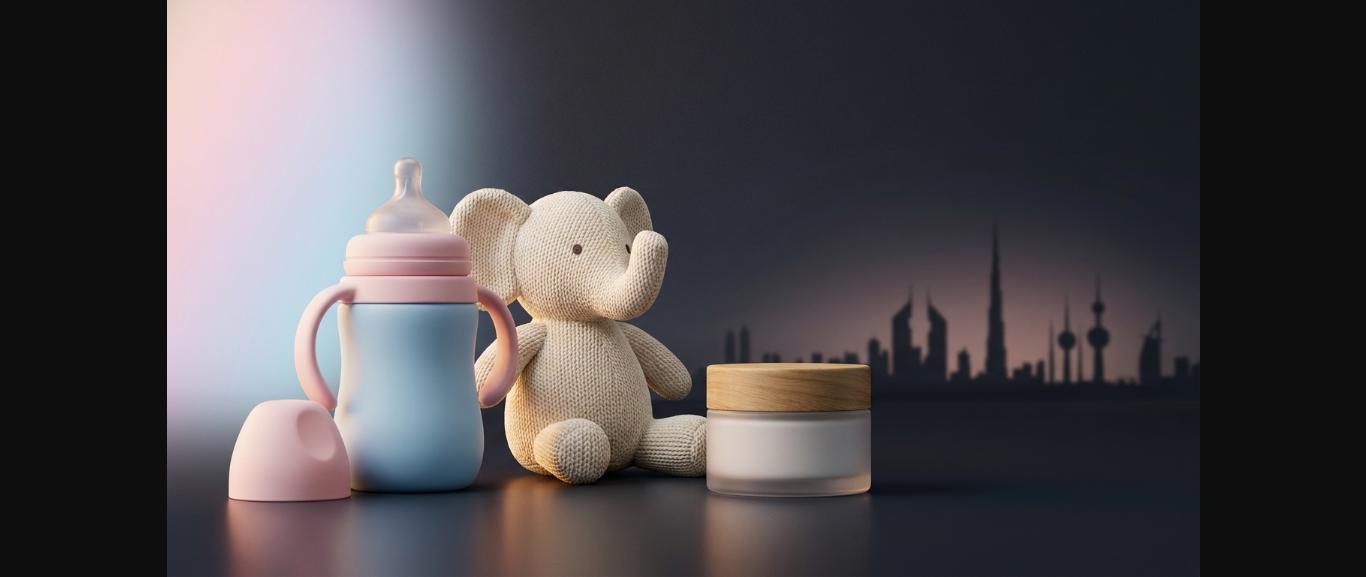
The UAE online baby products market is worth roughly 1.2 billion dollars, and the wider baby care category is growing at close to 4.2 percent a year, driven by young families, rising incomes, and a clear shift toward premium, safety focused products. Parents shopping this category are not browsing casually. They are evaluating material safety, size accuracy, and build quality before they ever add to cart.
That evaluation happens almost entirely through product images, since a parent buying a bottle, a car seat, or a soft toy online cannot physically inspect the product the way they would in a store. The imagery has to do the work that touch and inspection would normally do, showing material texture, safety features, and construction detail clearly enough that a parent feels confident buying something their child will use.
Dubai baby and kids brands are using CGI to meet that bar, because CGI renders material and construction detail with a level of accuracy that a rushed photography session often cannot match, and because it scales to cover every size, stage, and color variant a growing baby product catalog actually needs.
Why Baby Products Are a Higher Trust Category Than Most
Parents shopping for their children apply a different standard than shoppers in almost any other category, and that standard shows up directly in what product imagery needs to communicate.
The Safety and Accuracy Bar Parents Hold Brands To
A parent evaluating a baby bottle wants to see the nipple material clearly, the measurement markings, how the parts disassemble for cleaning. A parent evaluating a car seat wants to see the harness system, the padding, the actual scale relative to a child. These are not aesthetic preferences, they are safety and usability questions, and a product image that does not answer them clearly creates hesitation in a category where hesitation is especially strong.
Where Photography Struggles With Baby Products
Baby product catalogs grow fast, new sizes as children age through stages, new colors, new safety certifications that sometimes change packaging. Photography struggles to keep pace with that growth the same way it does in any fast moving category, and the cost of an inaccurate image is higher here than almost anywhere else, since parents notice discrepancies between the listing and the delivered product immediately and are far less tolerant of the mismatch.
Ways CGI Builds Parent Trust for Dubai Baby Brands
Material and Safety Detail Rendered Accurately
CGI renders reproduce the actual material specification of a product, whether that is medical grade silicone, BPA free plastic, or organic cotton, with the texture and finish accuracy that lets a parent see exactly what the material looks and feels like. This level of accuracy directly addresses the safety scrutiny parents apply to this category.
Every Size and Stage Variant Covered
A single product line often spans multiple sizes as a child grows, newborn, infant, toddler, each needing its own accurate imagery. CGI produces every stage variant from the same base 3D model with proportion adjustments, at a fraction of what a separate photography session per stage would require.
Consistent Imagery Across a Fast Growing Catalog
As a baby brand's catalog grows, CGI keeps every SKU visually consistent in lighting, background, and presentation style, which matters more in this category than most because parents often compare products side by side within a brand's own catalog before choosing between sizes or variants.
Lifestyle Scenes Without a Nursery Set Build
Lifestyle imagery showing a product in a nursery or play context normally requires building and styling a full set, which is expensive and slow to repeat across a catalog. CGI produces that same nursery or lifestyle context digitally, reused across every product in the catalog without rebuilding a physical set each time.
Packaging and Ingredient Callouts Parents Actually Read
Parents read ingredient lists, safety certifications, and material callouts on baby products more closely than almost any other shopper reads product packaging. CGI produces callout graphics highlighting these details at a resolution that stays legible even when a parent zooms in to check a certification mark or ingredient list.
Why This Matters More in a Premiumizing Market
The UAE baby products market is shifting toward premiumization, with parents increasingly willing to pay more for products they trust on safety and quality. That shift raises the stakes on product imagery, since a premium price point requires premium looking, premium feeling imagery to justify it, and CGI produces that quality consistently across a full catalog rather than only on a brand's hero products.
Brands that under invest in imagery quality in this category are not just losing a sale, they are working against a shopper base that specifically associates visual quality with product safety and trustworthiness.
SMAPIT: CGI Built for Baby and Kids Brand Trust
SMAPIT produces CGI product visualization for Dubai baby and kids brands with the accuracy and consistency this category demands, material detail that holds up to close inspection, every size and stage variant covered, and lifestyle scenes that build parental confidence without a nursery photoshoot.
We work from product specifications, safety certifications, and material references to deliver complete image sets, every variant, every platform format, in three to seven business days depending on catalog size.
For Dubai baby and kids brands whose catalog has grown faster than their photography can keep up with, the conversation starts with your current product line and which stages or variants need coverage.
Frequently Asked Questions
Can CGI accurately show safety features like harness systems or locking mechanisms?
Yes. CGI models are built from actual product specifications, which means functional details like harness systems, locking mechanisms, and assembly points can be rendered accurately and even shown in exploded or detail views that photography cannot easily produce.
How does CGI handle certification marks and safety labeling?
Certification marks and safety labels are part of the product artwork applied to the 3D model, rendered at a resolution that keeps them legible even when a parent zooms in, which matters since these details are frequently checked closely by parents evaluating safety.
Can the same 3D model cover multiple sizes as a child grows?
Yes. A base 3D model can be adjusted in scale and proportion to produce accurate renders for each size stage, newborn through toddler for example, without building each size as a completely separate model from scratch.
Does CGI work for soft goods like plush toys or fabric products?
Yes. CGI material rendering handles fabric texture, stitching detail, and soft good construction accurately, though soft goods with complex irregular shapes sometimes need more detailed reference material to achieve an accurate result.
How important is lifestyle imagery for baby product conversion?
Very important. Parents respond strongly to seeing a product in a realistic use context, a bottle being used, a toy in a play setting, which is why lifestyle scenes are a standard part of baby product image sets rather than an optional extra.
What happens if our baby product catalog spans many small SKU variants?
This is one of the strongest use cases for CGI. Small variants, colors, prints, sizes, are material and artwork swaps on the same 3D model, which makes covering a large variant count far more practical than a comparable photography approach.