Every ecommerce brand is asking the same question in 2026. AI image generation has gone from experimental to accessible in under three years. Midjourney, DALL-E, Firefly, and a dozen vertical tools now let anyone generate a convincing product-looking image from a text prompt in under thirty seconds. Meanwhile, CGI studios are producing renders that are indistinguishable from high-end photography.
So which one should your brand actually use?
The honest answer is more nuanced than either camp wants to admit. CGI defenders often ignore how far AI has come. AI evangelists often ignore where it still fails catastrophically for commercial use. This article gives you the real breakdown — no hype, no agenda — so you can make the right call for your brand.
What We Mean by CGI and AI Images
Before comparing them, let's be precise about what each term actually means in a commercial production context, because both are often used loosely.
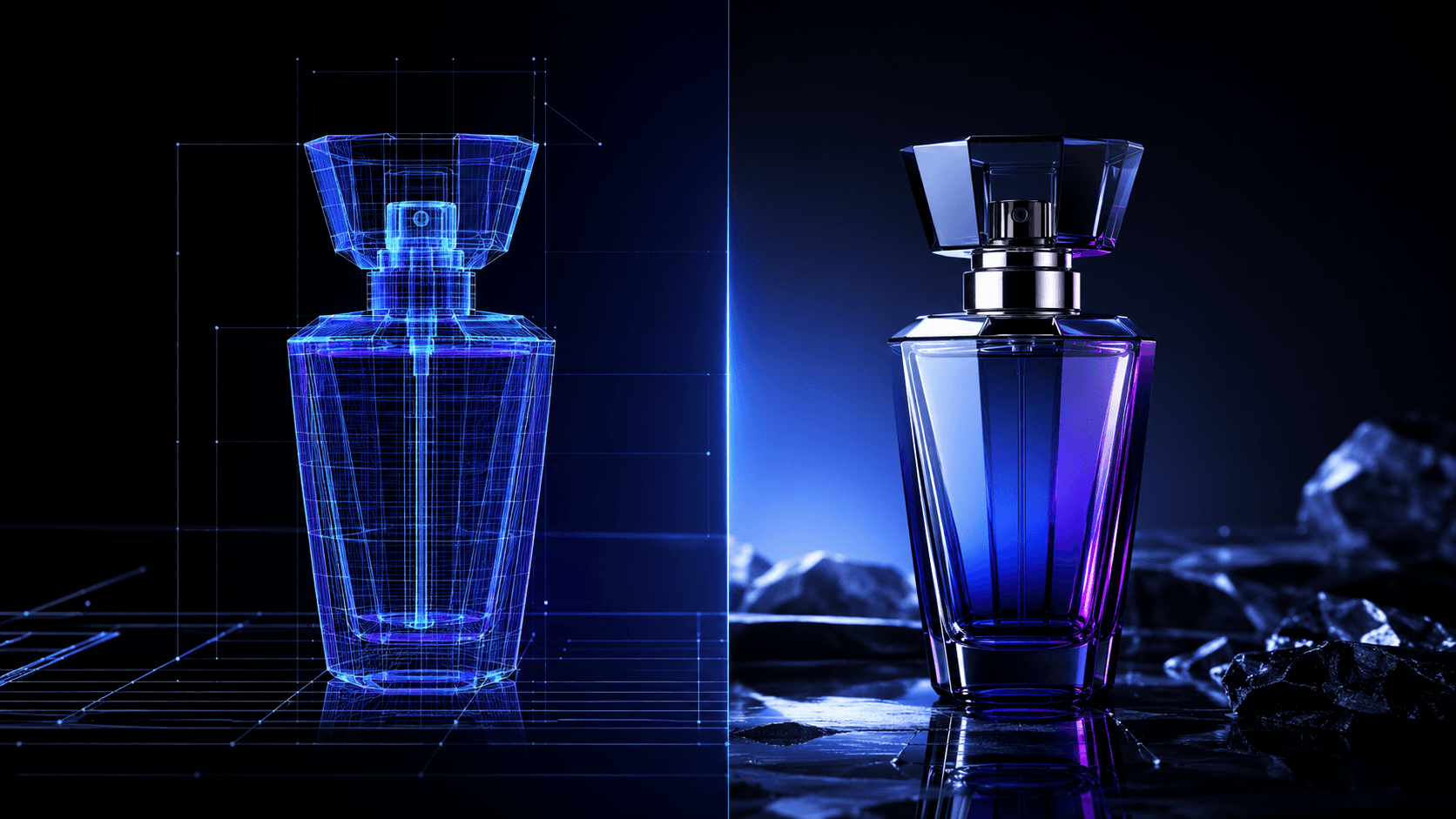
CGI (Computer Generated Imagery) in product visualization refers to a human-directed 3D production pipeline. A 3D artist builds a precise model of your product, sets up lighting and environments, and renders the final image using software like Cinema 4D, Blender, or Houdini. Every element is intentional and controllable. The output is a photorealistic image built from your exact product specifications.
AI images in a commercial context most commonly refer to outputs from generative AI models — systems trained on billions of images that produce new visuals from text or image prompts. Tools like Midjourney, Adobe Firefly, DALL-E 3, and specialized ecommerce tools like Claid or Pebblely fall into this category. The model generates something that looks like your product based on learned patterns — not from your actual product data.
This distinction matters enormously when you start measuring commercial performance.
Where AI Images Win
Let's give AI its due credit. In several specific scenarios, AI-generated imagery is genuinely the better tool.
Speed for concepting and testing — Need to explore ten different background aesthetics for a campaign before committing to production? AI generates them in minutes. For creative concepting, mood boarding, and A/B test ideation, AI is dramatically faster than any CGI pipeline.
Low-stakes social content — For Instagram story backgrounds, lifestyle filler content, and editorial-style mood imagery where product accuracy is not the primary goal, AI output is often good enough and produced at a fraction of the cost.
Small brands with limited budgets — A solo founder selling on Etsy or launching a first product run may not have the budget for a full CGI pipeline. AI tools give them a starting point that is meaningfully better than a phone photo on a kitchen counter.
Background and environment generation — AI is exceptionally good at generating photorealistic environments, room settings, and atmospheric backgrounds. This is where it has genuinely closed the gap with expensive location shoots.
Where CGI Wins — And Where AI Visibly Fails
This is the part that AI-generated image tools are reluctant to talk about. For commercial ecommerce use, AI has consistent failure modes that are not minor inconveniences — they are conversion killers.
Product accuracy — AI generates what a product like yours typically looks like based on training data. It does not know what your specific product looks like. Label text is consistently wrong, distorted, or hallucinated. Logos are warped. Specific color values shift. Unique packaging shapes are approximated, not replicated. For brands where brand accuracy is non-negotiable — which is every brand on a marketplace — this is a fundamental problem.
Consistency across SKUs — A CGI model, once built, produces pixel-perfect consistent output across every angle, variant, and campaign. AI regenerates a new interpretation every time. If your red variant and blue variant need to look like they came from the same shoot, AI will struggle to deliver that consistency at scale.
Material rendering for complex surfaces — Glass, liquid, transparent packaging, polished metal, gemstones — AI handles these materials with inconsistent accuracy. CGI software simulates real-world physics: light refraction through glass, caustics on water, subsurface scattering in skin-like materials. The difference is immediately visible to consumers, and it directly affects purchase confidence.
Marketplace compliance — Amazon, Flipkart, and most major marketplaces have strict image requirements: accurate product representation, no misleading visual elements, specific technical specifications. CGI renders built from your product specs pass these requirements. AI-generated images with hallucinated product details fail them — and getting flagged for inaccurate product imagery has serious seller consequences.
Pre-launch production — CGI works from CAD files and specs before your product physically exists. AI cannot accurately generate your specific unreleased product — it can only produce something that vaguely resembles it based on category patterns.
The Real Numbers: How They Compare in 2026
Visual commerce spending will account for 42% of total ecommerce investment by the end of 2026 — and brands that get product imagery right see the results directly in conversion rates. Here is how CGI and AI compare across the metrics that matter:
Turnaround — AI: minutes to hours. CGI: 3–7 business days for a first render, significantly faster on existing models.
Cost for a single hero image — AI: near zero with a subscription tool. CGI: ₹5,000–₹25,000 depending on complexity and studio.
Product accuracy — AI: inconsistent, especially on labels, logos, and material specifics. CGI: exact, built from your actual product data.
Consistency across variants — AI: low, each generation is a new interpretation. CGI: perfect, same model used across all outputs.
Marketplace compliance — AI: risky, hallucinated details can violate listing policies. CGI: reliable, built to spec.
Scalability — AI: extremely high, unlimited variations at near-zero marginal cost. CGI: high at catalog scale, costs decrease significantly with volume.
Creative range — AI: vast but uncontrolled. CGI with AI enhancement: vast and controlled.
The Answer Most Studios Won't Tell You
The real answer in 2026 is not CGI or AI. It is CGI-grounded, AI-enhanced production — and that is a meaningfully different thing from either option used alone.
The best product visualization studios in 2026 are not choosing between CGI and AI. They are using AI as an accelerant layered on top of 3D precision. The product is modeled accurately in 3D first — giving you the accuracy, consistency, and compliance that pure AI cannot provide. AI tools then handle environment generation, background variations, lighting enhancement, and creative iteration at speed — giving you the range and volume that traditional CGI pipelines could not deliver affordably.
This hybrid approach produces output that is simultaneously more accurate than pure AI and faster than traditional CGI. For ecommerce brands, it means photorealistic visuals that are brand-accurate, platform-compliant, and produced at the speed and scale that modern campaigns demand.
How to Decide What's Right for Your Brand
Use AI images when: You are concepting a campaign and need to explore visual directions quickly. You need lifestyle or atmospheric content where your specific product details are not the focal point. You are a very early-stage brand with minimal budget and need placeholder visuals to begin building. You need large volumes of background variations or environmental imagery.
Use CGI when: Your product has specific packaging, labels, logos, or unique materials that must be represented accurately. You are listing on Amazon, Flipkart, or any marketplace with image compliance requirements. You need consistent imagery across multiple SKUs, colors, or variants. You are launching a product before physical inventory exists. You need campaign imagery that will run in paid ads, print, or any context where inaccuracy has real consequences.
Use CGI with AI enhancement when: You want the accuracy and consistency of CGI with the creative range, variation speed, and cost efficiency that AI brings. This is the approach that serious ecommerce brands are increasingly building into their production pipelines in 2026 — and it is the approach that produces the best commercial results.
What This Means for Ecommerce Brands in India
India's ecommerce market is at an inflection point. D2C brands are scaling faster, marketplaces are raising their visual quality bars, and the brands that will win the next five years are the ones building production infrastructure now — not scrambling to keep up later.
The brands defaulting to pure AI image generation for their product listings are saving money in the short term and leaving conversion performance on the table in the long term. The brands investing in CGI-grounded, AI-enhanced visualization are building visual assets that work harder, last longer, and scale without rebuilding from scratch every season.
SMAPIT's Approach: The Best of Both
At SMAPIT, every project starts with 3D precision and ends with AI-enhanced quality. We build accurate 3D models of your product — capturing every material, label, and surface detail exactly as it should appear. We then use AI tools to generate environments, expand creative variations, and accelerate iteration cycles in ways that traditional CGI pipelines never could.
The result is photorealistic product imagery that is brand-accurate, platform-compliant, faster than a photoshoot, and more creatively flexible than either pure CGI or pure AI can deliver alone. It is not a compromise between two options — it is the production approach that 2026's visual commerce demands.
Frequently Asked Questions
Can AI completely replace CGI for ecommerce product images? Not for commercial ecommerce use in 2026. AI generates approximations based on training patterns, not accurate representations of your specific product. For marketplace listings, paid advertising, and any context where product accuracy matters, CGI-grounded production remains essential.
Is AI product image generation good enough for Amazon listings? AI-generated product images carry significant risk for marketplace listings. Hallucinated label text, inaccurate logos, and incorrect product details can violate marketplace image policies and result in listing suppression. CGI renders built from your actual product specifications are the reliable choice for compliant marketplace imagery.
How much does CGI product visualization cost compared to AI? AI tools cost near zero per image with a subscription. CGI renders range from ₹5,000 to ₹25,000 per final image depending on complexity. However, the correct comparison is not cost per image — it is cost per converting image. CGI renders that accurately represent your product and pass marketplace compliance convert at significantly higher rates than AI-generated approximations.
What is CGI-enhanced AI production? CGI-enhanced AI production — also called AI-powered 3D visualization — starts with a precise 3D model of your product built using standard CGI workflows, then uses AI tools to generate environments, create variations, and accelerate the production timeline. The output combines the accuracy of CGI with the speed and creative range of AI.
Which type of product visualization is best for D2C brands in India? For D2C brands in India building for ecommerce scale, CGI-grounded AI-enhanced production offers the best combination of product accuracy, platform compliance, creative flexibility, and cost efficiency at scale. Studios like SMAPIT specialize in exactly this approach for the Indian D2C market.