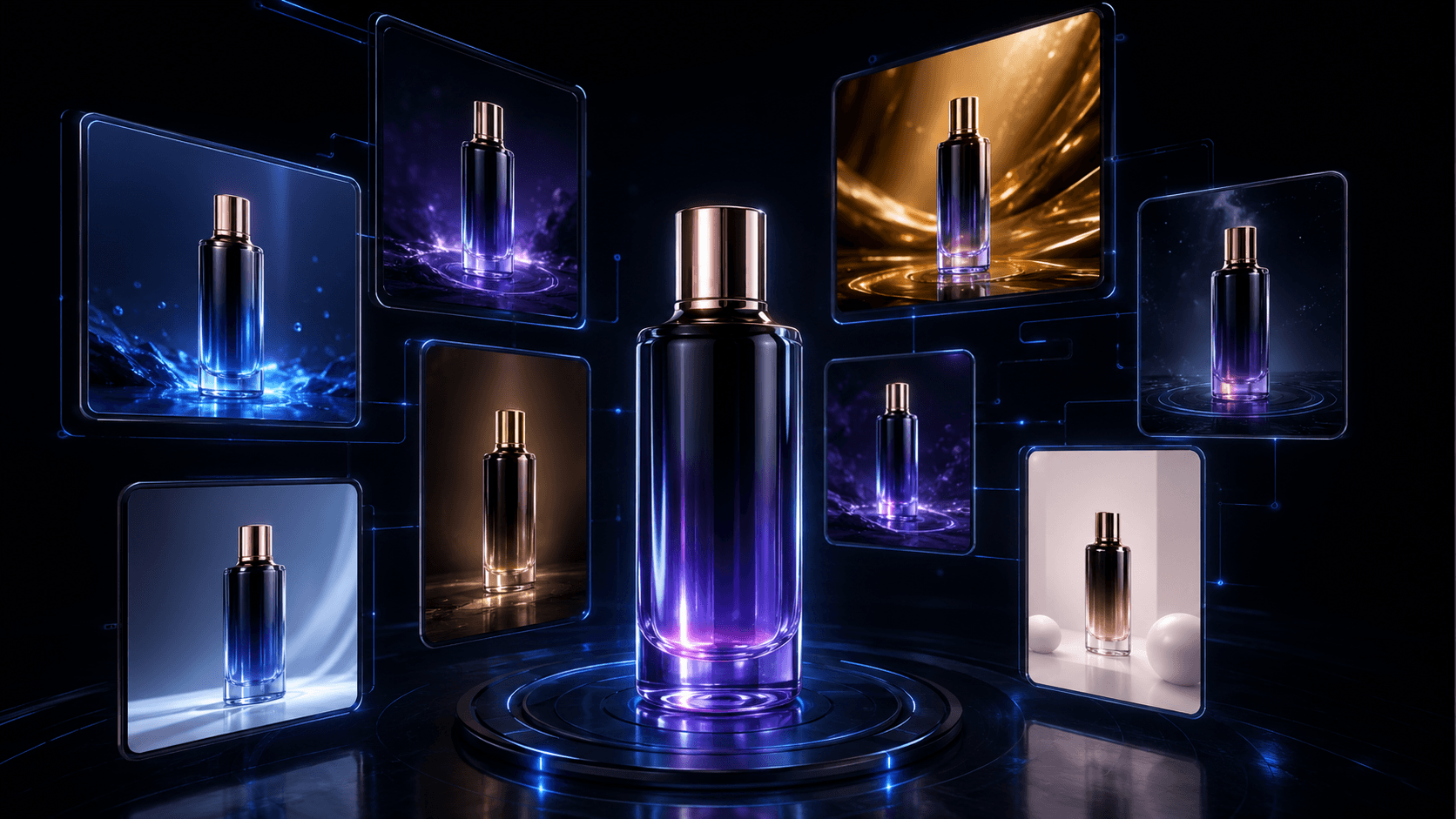
A campaign that once required a studio booking, a product sample, a full crew, and three weeks of lead time now runs entirely on CGI. No photographer. No stylist. No location scout. No sample shipping. No reshoot when the brief changes.
The ecommerce brands that figured this out first are producing more ad creative, testing faster, finding winning creatives sooner, and spending less on production than every competitor still running a traditional shoot pipeline. CGI ad creatives built from 3D assets are now running at scale on Meta, Google Display, TikTok, and YouTube — and the performance data behind them is making the switch from photography to CGI an obvious decision for any brand serious about paid growth.
This is how it works, why it outperforms, and how your brand can build the same pipeline.
What Are CGI Ad Creatives?
CGI ad creatives are paid advertising visuals — static images, animated clips, video loops, and carousel assets — produced entirely using 3D modeling and rendering rather than photography or live video production.
Instead of booking a studio and shooting new content for every campaign, brands with a CGI pipeline produce a precise 3D model of their product once. That model then becomes the master asset for unlimited ad creative production — different backgrounds, different lighting moods, different compositions, different motion treatments, different seasonal contexts — all rendered digitally at a fraction of the cost and timeline of a new photoshoot.
The result is ad creative that is photorealistic, brand-accurate, and infinitely variable. On a product page, customers may not be able to tell whether an image was shot or rendered. In a paid ad competing for attention in a feed, CGI creative consistently holds its own against photography — and in many performance comparisons, outperforms it.
Why Traditional Creative Production Breaks at Paid Ad Scale
To understand why CGI ad creatives have become the production standard for scaling ecommerce brands, it helps to understand exactly where traditional photography breaks down in a paid advertising context.
Paid social advertising in 2026 demands creative volume at a scale that most brand marketing teams did not anticipate when they built their production workflows. A single Meta campaign at meaningful spend requires multiple ad sets, each testing multiple creatives, each creative needing platform-specific size variations. A brand running campaigns across Meta, Google Display, TikTok, and YouTube simultaneously needs dozens of creative variants just to populate a single campaign cycle.
Photography produces one image per setup. To get ten genuinely different creative variants — different backgrounds, different angles, different lighting — you need ten different setups, potentially across multiple shoot days. Every iteration costs money, takes time, and requires the product to be present and available.
The math breaks at scale. Brands spending meaningfully on paid ads consistently hit a creative production bottleneck — the team knows they need more variants to test, but the production pipeline cannot supply them fast enough or affordably enough to keep pace with spend.
CGI breaks that bottleneck entirely.
How CGI Ad Creatives Are Produced
The production process for CGI ad creatives follows a straightforward pipeline once the initial 3D model is built.
Step 1 — Build the 3D Product Model
The foundation of the entire CGI ad creative pipeline is a precise 3D model of your product. This is built once — from product samples, CAD files, packaging dielines, or detailed reference photography — and becomes the permanent master asset that powers every ad creative produced from that point forward.
The quality of this model determines the quality of every render that comes from it. A well-built 3D model captures every material detail — glass thickness, label artwork, surface finish, component geometry — with the accuracy that makes subsequent renders look like the product, not a generic approximation of it.
Step 2 — Define Creative Briefs by Campaign
Rather than booking a studio, the creative team briefs the 3D studio on what they need for each campaign cycle. Background colors and textures. Lighting mood. Product angle and composition. Motion or static. Seasonal context or clean product focus. These decisions, which in a photography workflow require a full shoot day to execute, become render parameters that can be changed and re-rendered in hours.
Step 3 — Render Creative Variants
From a single approved 3D scene setup, the studio renders every required variant. Five background colorways for A/B testing. Three different lighting treatments. Hero shot and square crop and vertical story format. Static and a three-second loop. All from the same model, the same session, with only the specified parameters changing between renders.
This is the core efficiency of CGI ad creative production — the marginal cost of producing an additional variant from an existing 3D setup is a fraction of what a separate photography setup costs. Testing creative variables at the volume that drives paid ad performance becomes economically viable.
Step 4 — Motion and Animation
CGI ad creative goes beyond statics. Product rotation loops, floating animations, ingredient reveal sequences, dynamic lighting transitions — motion ad formats that perform strongly on TikTok, Instagram Reels, and YouTube pre-roll can be produced entirely in CGI without a video crew.
A fifteen-second product reveal animation built in 3D costs a fraction of an equivalent live-action video production — and can be re-versioned for different platforms, different durations, and different campaign angles from the same base animation file.
Step 5 — Platform Optimisation and Delivery
Final renders are delivered in every required format and specification — 1080x1080 for feed, 1080x1920 for Stories and Reels, 1200x628 for Google Display, with platform-specific file size and format requirements met. A single CGI creative brief produces a complete, platform-ready asset library rather than a single image that then needs to be cropped and reformatted.
The Performance Case: Why CGI Ad Creatives Convert
The production efficiency argument for CGI is compelling on its own. The performance argument makes it definitive.
More Variants Means Faster Winning Creative Discovery
The most consistent finding in paid social creative testing is that more variants tested produces better winners faster. A brand testing ten creative variants finds its top performer faster than a brand testing three — and the winning creative, once found, can run at higher spend with better efficiency.
CGI makes testing ten or twenty variants in a single campaign cycle economically viable for the first time. Photography budgets typically allow three to five creative variants per campaign. CGI budgets allow ten, fifteen, or twenty — with each additional variant costing a fraction of what a photography equivalent would require.
The brands that find their winning creative first scale their spend faster and more efficiently. CGI is the production infrastructure that makes that pace of testing possible.
Consistent Brand Accuracy Across Every Creative
Every CGI ad creative produced from the same 3D model is pixel-perfect brand-accurate. The product color is exactly the brand color. The label text is exactly the label text. The material finish is exactly the material finish. There is no variation between the product as it appears in the ad and the product as it arrives in the customer's hands.
This consistency matters for ad performance because expectation mismatch — when the ad shows a product that looks different from what arrives — drives returns and negative reviews that compound cost-per-acquisition over time. CGI accuracy eliminates that source of post-purchase friction.
Seasonal and Campaign Flexibility Without Reshoots
A brand running seasonal campaigns — Diwali, Valentine's Day, summer launch, year-end sale — traditionally needs either a dedicated shoot for each season or generic evergreen creative that does not lean into seasonal context. Neither is ideal.
With a CGI pipeline, seasonal campaign creative is a background and lighting change on an existing 3D scene. The Diwali version gets warm gold tones and celebratory elements. The Valentine's version gets a rose and soft pink palette. The summer version gets an outdoor environment and bright daylight simulation. All produced from the same model, in the same week, at a cost that makes seasonal creative refresh viable for every campaign cycle — not just major hero launches.
Dynamic Creative Optimisation at Scale
Meta's Dynamic Creative Optimisation and Google's responsive ad formats algorithmically test combinations of creative elements to find the best-performing combination for each audience segment. To fully leverage these systems, brands need a large library of creative components — multiple product images, multiple background options, multiple composition treatments.
CGI is the only production method that can supply that creative library at the volume these systems need to work properly. Photography simply cannot produce enough variants, affordably enough, to feed DCO at scale. CGI can.
What CGI Ad Creative Looks Like Across Platforms
Different paid platforms have different creative requirements, and CGI handles all of them from a single 3D asset.
On Meta and Instagram, CGI statics and short loops in feed and Story formats drive the highest volume of ecommerce ad spend. The ability to produce multiple colorway variants and lifestyle contexts makes CGI particularly valuable for carousel ads, where each card in the carousel can show the same product in a different environment or angle.
On TikTok, CGI product animations and reveal sequences that feel native to the platform's aesthetic — fast cuts, dynamic motion, bold compositions — are produced in 3D and perform alongside UGC content in performance comparisons.
On Google Display, CGI creative in multiple size formats and colorways populates responsive display ad campaigns with brand-accurate visuals that maintain consistency across every placement.
On YouTube pre-roll, six-second CGI bumper ads showing a product in dramatic motion or a single hero composition communicate brand quality in the time available without requiring a full video production.
Building a CGI Ad Creative Pipeline: What You Need
For an ecommerce brand moving from photography to CGI for paid ad creative, the transition involves three components.
A High-Quality 3D Model Library
The first investment is building 3D models of your hero products. This is the foundational infrastructure cost — paid once, used indefinitely. For most brands, starting with the top three to five SKUs by ad spend covers the majority of paid creative requirements. The model library grows with each new product launch.
A Briefing Process Built for CGI
Working with a CGI studio is different from briefing a photographer. Creative briefs need to specify background environment, lighting mood, camera angle, motion requirements, and platform format requirements. Building a brief template that captures these parameters efficiently — rather than relying on a mood board and hoping for the best — significantly speeds up production cycles.
A Testing Framework That Uses the Volume
The value of CGI ad creative is realised through testing. Brands that build a CGI pipeline but run the same two or three creatives they would have run with photography are leaving the core benefit unused. A testing framework that systematically explores background, lighting, angle, motion, and seasonal context variables — using the volume of variants CGI makes possible — is what drives the performance uplift.
SMAPIT: CGI Ad Creatives Built for Paid Performance
SMAPIT produces CGI ad creatives for ecommerce brands running paid campaigns on Meta, Google, TikTok, and YouTube. Every project starts with a precision 3D model of your product and ends with a platform-ready creative library — statics, loops, animations, and seasonal variants — built to the specifications your campaigns need.
Our AI-enhanced production pipeline means faster turnaround on every campaign cycle, more variants per brief, and consistent brand accuracy across every creative that goes into your ad account. For brands that are tired of their creative production bottleneck limiting their paid scale, CGI is the infrastructure fix — and SMAPIT is the studio that builds it.
Frequently Asked Questions
Can CGI ad creatives actually compete with photography in paid ads? Yes — and in many performance comparisons, CGI creatives outperform photography. The primary reason is volume: CGI allows brands to test significantly more creative variants in a single campaign cycle, which leads to faster discovery of winning creatives that photography-limited brands never find.
How many CGI ad creative variants can be produced from one 3D model? Unlimited. Once a 3D model is built and approved, any number of creative variants — different backgrounds, lighting treatments, angles, motion formats, platform sizes, and seasonal contexts — can be rendered from it. The marginal cost per additional variant is a fraction of the original modeling cost.
What platforms are CGI ad creatives used on? CGI ad creatives are used across Meta, Instagram, Google Display, TikTok, YouTube, Snapchat, and Pinterest. A single 3D asset brief produces platform-ready creative in every required format and specification.
How long does it take to produce CGI ad creatives? For a brand with an existing approved 3D model, a full campaign creative brief — ten to fifteen variants across multiple formats — typically delivers in three to five business days. First-time productions requiring 3D modeling deliver in five to ten business days depending on product complexity.
Is CGI ad creative production affordable for growing D2C brands? Yes. The economics of CGI ad creative improve significantly at scale. The 3D model is built once; every subsequent creative brief is a render cost only. For brands running monthly campaign cycles, the cumulative cost per creative variant produced over six months is significantly lower than an equivalent photography pipeline.
Do CGI ad creatives work for video ad formats? Yes. 3D animation enables product rotation loops, reveal sequences, dynamic lighting transitions, and motion compositions for video ad formats across TikTok, Instagram Reels, YouTube pre-roll, and Meta video placements — all without a video crew or live-action production budget.