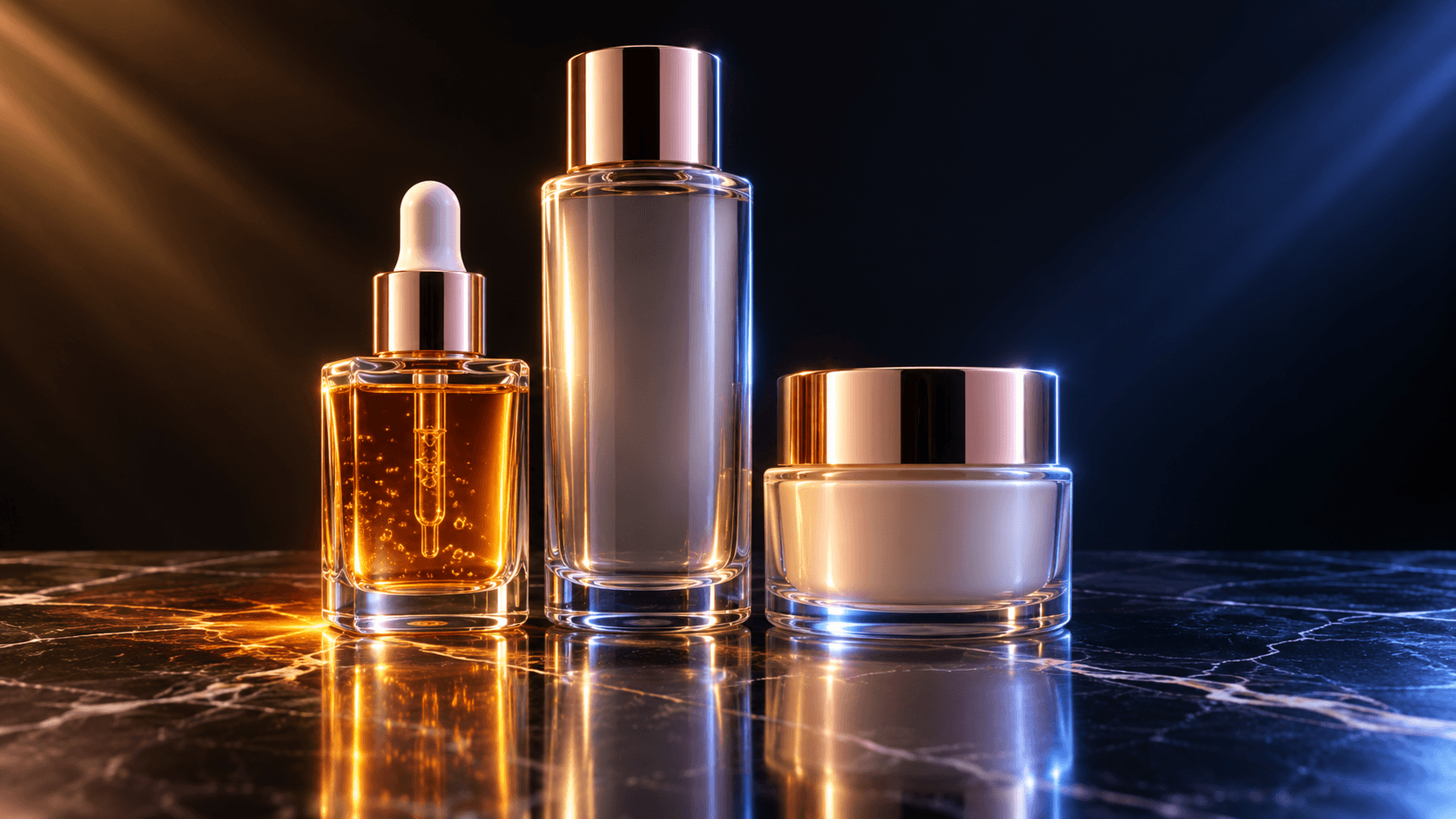
Glass serums. Frosted moisturiser jars. Liquid foundations catching light at an impossible angle. Perfume bottles floating in a galaxy of petals without a single string in sight.
The most beautiful beauty and skincare imagery you see online is not photography anymore. It is 3D product visualization — and the gap between what CGI can produce and what a studio shoot can replicate is only widening.
For beauty and skincare brands, this shift is not just a production upgrade. It is a strategic advantage. The category that has the most to gain from photorealistic CGI is also the one where visual quality most directly determines purchase decisions. This is the complete guide to 3D product visualization for beauty and skincare brands — what it is, how it works, what it costs, and why the brands doing it are converting better than the ones still booking studios.
Why Beauty & Skincare Is the Perfect Category for 3D Visualization
No product category benefits more from 3D visualization than beauty and skincare. Here is why the fit is so precise.
Beauty products are purchased almost entirely on visual trust. A customer buying a serum online cannot smell it, touch it, or test it. Their entire purchase decision is built on what they can see — the clarity of the liquid, the quality of the packaging, the finish of the cap, the precision of the label. The visual is not a supporting element of the product page. It is the product page.
At the same time, beauty products are among the most visually complex objects to photograph well. Glass reflects everything around it. Liquids shift under every light change. Metallic caps create unpredictable specular highlights. Frosted surfaces require precise lighting to show their texture without going flat. Getting all of these right in a single shot, consistently, across an entire range, is genuinely difficult — and expensive.
3D visualization solves both sides of this equation at once. It produces imagery with the visual complexity and material accuracy that beauty products demand, with perfect control over every element, and at a fraction of the cost and timeline of a studio shoot.
What 3D Product Visualization Looks Like for Beauty Brands
Before getting into the how and why, it helps to understand what 3D visualization actually produces for a beauty or skincare brand. The deliverables fall into several categories:
Hero Product Renders
The foundation of any beauty brand's visual library — a single product, shot against a clean or gradient background, with cinematic lighting that captures every material detail. For a glass serum bottle, this means accurate light refraction through the glass, correct liquid depth and color, precise label rendering, and a metallic or frosted cap that catches light the way it does in reality. This is the image that goes on the product page, the Amazon listing, and the hero banner.
360-Degree Render Sets
A complete set of renders — typically eight to twelve angles — showing the product from every relevant perspective. Front, back, side profile, three-quarter angle, cap detail, base, label close-up. For a brand selling on a marketplace where customers zoom in and rotate products, a comprehensive angle set is the difference between a customer who buys and one who leaves to find a competitor with better imagery.
Lifestyle Composite Renders
The product placed into a photorealistic environment — a marble bathroom shelf, a vanity table with soft morning light, a minimalist skincare tray surrounded by botanicals. The environment is CGI; the product is CGI; the result is aspirational lifestyle imagery that drives the emotional purchase trigger without requiring a location scout, a set build, or a photographer.
Ingredient and Texture Visualization
A category-specific capability that beauty brands use extensively — close-up renders showing product texture, ingredient particles, liquid consistency, or formulation detail. A hyaluronic acid serum shot with visible moisture droplets. A clay mask showing the texture of the formulation. A cream with visible skin-absorption motion. These visuals communicate product efficacy in a way that builds purchase confidence beyond what standard product shots achieve.
Colour Variant Libraries
One of the highest-value applications for makeup and cosmetic brands. Once a lipstick, foundation, or eyeshadow palette is modeled in 3D, every color variant is rendered from the same model — same lighting, same angle, same composition, with only the color value changing. Producing a thirty-shade lipstick range in perfect visual consistency takes days, not months.
Campaign and Ad Visuals
Beauty CGI for paid social, email, and digital advertising. Dynamic compositions, dramatic lighting, floating product arrangements, motion blur effects — visual language that performs in the feed and drives click-through rates that standard product photography rarely matches.
The Technical Challenges of Beauty CGI — And How They Are Solved
Beauty and skincare visualization has historically been considered one of the more technically demanding categories in 3D production. The materials involved — glass, liquid, frosted plastic, metallic finishes, cream textures — each require specialized rendering techniques. Here is how each challenge is handled in a professional production pipeline.
Glass and Transparent Packaging
Glass is one of the most complex materials to render accurately because it does both — it reflects the environment around it and transmits and refracts light through it simultaneously. A glass serum bottle needs accurate index of refraction values, correct caustic light effects beneath the bottle, and environmental reflections that feel natural rather than artificial.
Modern rendering engines handle glass physics with photorealistic accuracy. The key is the quality of the HDRI lighting environment and the skill of the artist in setting up the scene — both of which a specialist beauty visualization studio brings to every project.
Liquid and Formulation Rendering
Liquid inside a bottle presents two challenges — the volume itself and the interaction between the liquid and the container walls. An amber-tinted facial oil in a glass dropper bottle needs correct subsurface light transmission through the liquid, accurate meniscus at the top surface, and the right optical density for the specific color and viscosity.
Volumetric rendering techniques handle this with a level of accuracy that was not commercially achievable five years ago. The result is liquid that looks like liquid — not a painted surface that approximates it.
Frosted and Matte Surfaces
Frosted glass and matte plastic are deceptively difficult to photograph because their diffuse light scattering requires very specific lighting conditions to show their texture without going flat or blowing out. In CGI, the surface scattering properties are defined mathematically — and the lighting is set up to show that scattering accurately every time, with zero variation between renders.
Metallic Caps and Closures
Metallic pump heads, gold caps, and chrome closures require accurate environment reflections to look real. In a studio, this means controlling everything visible in the shooting environment — walls, lights, ceiling — to ensure clean reflections. In CGI, the reflection environment is built digitally and controlled precisely, producing metallic surfaces that catch light with the kind of cleanliness that studio photography rarely achieves consistently.
Cream and Gel Textures
Open-jar renders showing product texture — a white cream with a smooth swirl, a gel with translucent depth, a balm with visible gloss — use subsurface scattering and physically accurate surface tension simulation to produce textures that look tactile and real. This capability is particularly valuable for skincare brands where texture is a direct purchase signal.
The Production Process: From Brief to Final Render
If you have never commissioned 3D visualization for a beauty product before, here is what the process looks like from first contact to final delivery.
Step 1 — Reference and Brief
You provide product references — the physical product, packaging dielines, label artwork files, and CAD data if available. You also share your creative brief: the visual mood you are going for, reference imagery you like, the channels the renders will be used on, and any specific angles or compositions you need. The clearer the brief, the faster and more accurate the output.
Step 2 — 3D Modeling
The 3D artist builds a precise model of your product — bottle shape, cap, pump mechanism, label placement, glass thickness, liquid fill level. For complex beauty packaging with multiple components, this stage may take two to three days. The model is reviewed and approved by you before any rendering begins.
Step 3 — Material and Texture Setup
Every surface is assigned its physical material properties — glass with the correct refraction index, liquid with the correct optical density and color, label artwork applied with accurate print finish simulation, cap with its metallic or matte surface properties. This stage is where the technical expertise of a specialist beauty studio separates premium output from generic CGI.
Step 4 — Lighting and Scene Setup
The lighting environment, background, and camera angles are set up based on your creative brief. A beauty hero render typically uses a three-point lighting setup with an HDRI environment that gives the product clean, flattering light while maintaining the material complexity that makes glass and liquid look real.
Step 5 — Draft Renders and Revision
Low-resolution draft renders are shared for your review. At this stage you can request adjustments to lighting mood, camera angle, background color, or any compositional element. Most projects go through one to two revision rounds before moving to final production.
Step 6 — Final Delivery
High-resolution renders — typically 4000 x 4000 pixels or larger for product page use — are delivered in your required formats. Standard deliverables include PNG with transparent background for maximum placement flexibility, JPEG for direct platform use, and layered PSD files when post-production flexibility is required.
How 3D Visualization Compares to a Beauty Photoshoot
For beauty brands still running traditional photoshoots, here is an honest comparison across the dimensions that matter most.
Turnaround — A studio shoot for a skincare range takes two to four weeks from booking to final retouched delivery. 3D visualization delivers first renders in three to seven business days, with lifestyle composites typically in the same window.
Cost for a full range — A studio shoot for a ten-product skincare range including hero shots, lifestyle imagery, and variant coverage can run ₹2–5 lakh or more when studio rental, photographer fees, styling, props, and retouching are included. The same range in 3D — with more angles, more lifestyle options, and perfect consistency — is produced at a fraction of that cost, with dramatically lower marginal cost for every additional variant or campaign use.
Colour variant production — A twelve-shade lipstick range in photography means twelve separate shoots, twelve separate setups, and twelve separate retouching passes. In 3D, the same twelve shades render from one model in one session. The consistency is perfect; the timeline is days.
Creative flexibility — In a studio, you are committed to the decisions you make on shoot day. Changing the background color, the lighting mood, or the angle means a reshoot. In 3D, every one of those decisions is a render parameter that can be changed in hours.
Pre-launch production — Photography requires a finished, packaged product in hand. 3D visualization works from packaging dielines and CAD files — so your launch visuals are ready before your product leaves the manufacturer.
What Beauty Brands Should Look for in a Visualization Studio
Not every 3D studio produces beauty-category output at the quality level the category demands. When evaluating studios, look for these specific signals.
Glass and liquid portfolio — Ask specifically to see renders of transparent packaging, glass bottles, and liquid formulations. If a studio's portfolio does not include these material types at a high quality level, their general 3D capability will not compensate for the technical gap.
Label accuracy — A studio's ability to apply label artwork accurately — correct color values, print finish simulation, edge wrap on curved surfaces — is a direct indicator of how brand-accurate their output will be. Ask to see examples where label artwork was provided and compare it to the rendered output.
Lighting range — Does the studio produce only one lighting aesthetic, or can they match the mood of your brand's visual identity? Premium minimalist, warm editorial, clinical clean, dramatic luxury — a capable beauty studio should be able to work across these.
Lifestyle capability — Can they produce full lifestyle composite renders, or only packshot-style renders against clean backgrounds? For beauty brands running social and campaign content, lifestyle range is essential.
SMAPIT: Specialist Beauty & Skincare Visualization
SMAPIT has built one of the deepest beauty and skincare visualization portfolios of any Indian studio — with specific expertise in glass packaging, liquid formulation rendering, frosted surfaces, metallic finishes, and lifestyle composite production for the category.
Our AI-enhanced production pipeline means beauty brands get the visual quality of a premium CGI studio at turnaround times and price points that make the switch from photography an obvious decision. We work with D2C skincare startups, established beauty brands, and global cosmetics companies — producing hero renders, variant libraries, lifestyle composites, and campaign visuals across the full spectrum of what modern beauty brand visual production requires.
If your current imagery is not doing justice to your formulations and packaging, the solution is not a better photographer. It is a better production approach.
Frequently Asked Questions
Can 3D visualization accurately render glass skincare bottles? Yes. Modern CGI rendering engines simulate glass physics — refraction, reflection, caustic light effects, and liquid depth — with photorealistic accuracy. Glass skincare packaging is one of the most common and well-developed applications of beauty product visualization.
How does 3D visualization handle different lipstick or foundation shades? Once a lipstick or foundation product is modeled in 3D, every color variant is produced by changing the material color value and re-rendering — no additional modeling required. A thirty-shade lipstick range can be produced with perfect visual consistency in a fraction of the time and cost of a traditional shoot.
Do beauty brands need to send physical products for 3D visualization? No. A 3D studio works from packaging dielines, label artwork files, CAD data, and reference photographs. Physical samples can be helpful for material reference but are not required to begin production.
How long does 3D visualization take for a skincare product range? A single hero product with a full angle set typically delivers in three to seven business days. A multi-product skincare range with lifestyle composites typically delivers in two to three weeks depending on complexity and revision rounds.
Is 3D visualization affordable for indie beauty brands? Yes. The cost per render from a quality Indian studio like SMAPIT is broadly comparable to a professional photoshoot for a single product — and significantly more cost-efficient for any brand with multiple SKUs, color variants, or regular campaign refresh requirements. The 3D model, once built, eliminates the modeling cost for all future productions.
What file formats are beauty CGI renders delivered in? Standard delivery includes high-resolution PNG with transparent background, JPEG for direct platform use, and layered PSD files on request. Formats are confirmed based on your specific platform and usage requirements before production begins.